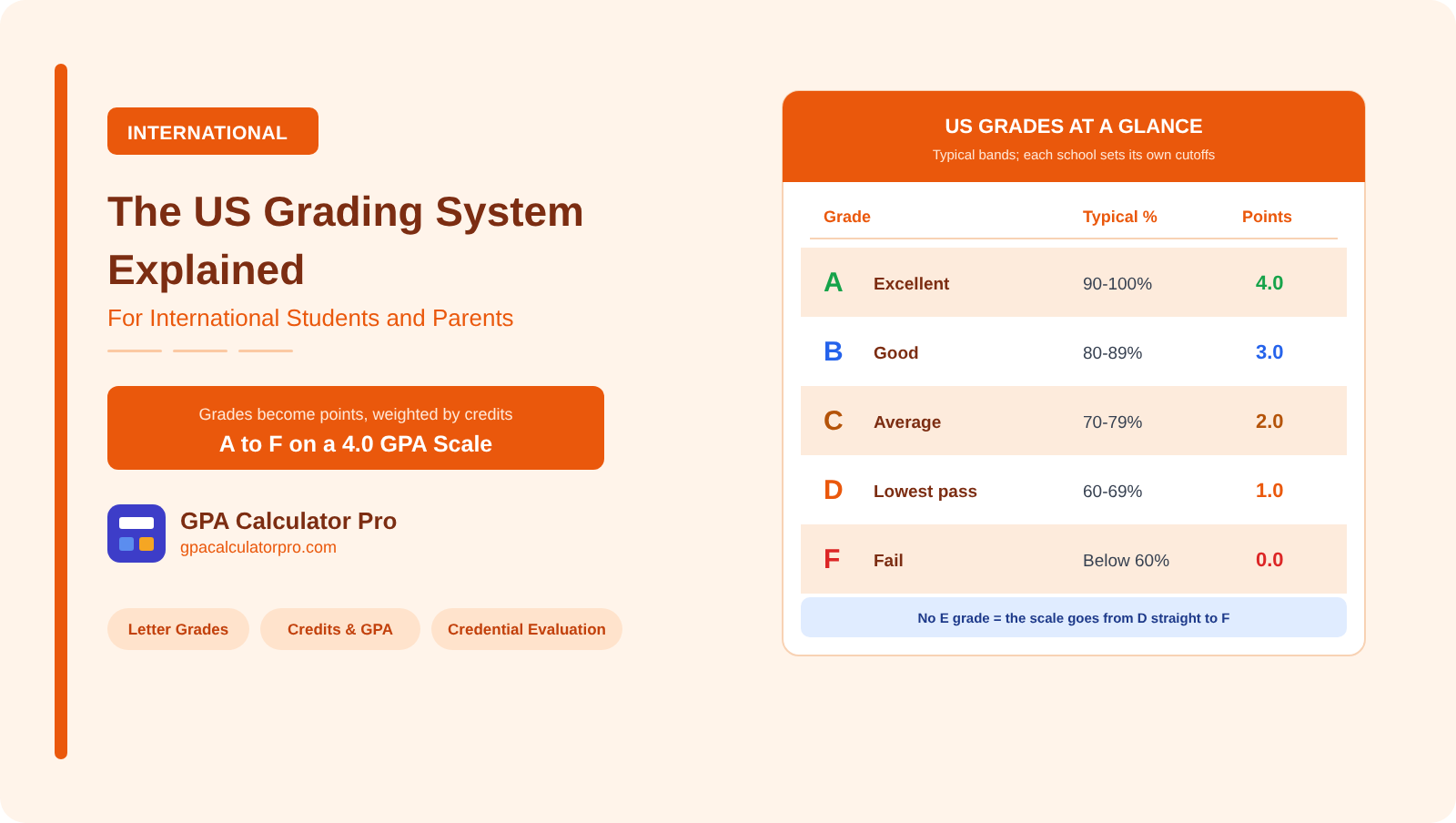
The US grading system gives each course a letter grade from A (excellent) to F (fail). Most schools turn those letters into grade points on a 4.0 scale (A = 4.0, B = 3.0, C = 2.0, D = 1.0, F = 0) and average them, weighted by credit hours, into a grade point average, or GPA. There is no single national rule: each school, and often each instructor, sets the exact percentage cutoffs.
This guide is for students and parents who are new to American schools. It explains the letters, the percentages behind them, how credits and GPA fit together, what a US transcript shows, and how your grades from home are compared when you apply.
US Grades at a Glance
The most common pattern uses ten-point bands. Treat the percentages as typical, not fixed:
| Grade | Typical % | Points | Meaning |
|---|---|---|---|
| A | 90‑100 | 4.0 | Excellent |
| B | 80‑89 | 3.0 | Good |
| C | 70‑79 | 2.0 | Average |
| D | 60‑69 | 1.0 | Lowest pass |
| F | Below 60 | 0.0 | Fail |
There is no E in most American schools: the scale jumps from D to F. Some schools set the cutoffs differently, for example an A from 93 percent, so always read the grading section of your course syllabus.
Plus and minus grades
Many colleges split letters with a plus or minus. Indiana University Indianapolis is a typical example of how those are worth slightly different grade points:
| Grade | Points | Grade | Points |
|---|---|---|---|
| A+ / A | 4.0 | C+ | 2.3 |
| A‑ | 3.7 | C | 2.0 |
| B+ | 3.3 | C‑ | 1.7 |
| B | 3.0 | D+ | 1.3 |
| B‑ | 2.7 | D / F | 1.0 / 0.0 |
Values from the IU Indianapolis grading scale, where an A+ counts the same as an A, and faculty can choose whether to use plus and minus grades. Some schools give an A+ 4.33 or skip some of these grades. To see how percentages map to letters on several common scales, try our Grade Calculator.
High School vs College Grading
The letters are the same at both levels, but how they are used differs:
| High school | College | |
|---|---|---|
| Grades | A‑F per class, often with honors and AP classes | A‑F per course |
| Credits | Usually counted per class or per year | Credit hours per course, often 3 or 4 |
| GPA | Often reported weighted and unweighted | Usually unweighted, on 4.0 |
| Rank | Some schools rank students | Rarely ranked; Latin honors instead |
In high school, honors, AP and IB classes often earn bonus points, so a weighted GPA can go above 4.0. That is explained step by step in how to calculate weighted GPA. Colleges usually report one unweighted GPA on the 4.0 scale.
Credits and How GPA Is Built
US colleges measure coursework in credit hours. The federal definition used by US colleges is roughly one hour of class plus about two hours of work outside class each week, for about fifteen weeks, for one semester credit. A typical class is worth 3 or 4 credits.
Your GPA is a credit-weighted average: multiply each course's grade points by its credits, add them up, and divide by the total credits. For one first-year semester:
| Course | Grade | Credits | Points |
|---|---|---|---|
| English Composition | A (4.0) | 3 | 12.0 |
| Calculus I | B+ (3.3) | 4 | 13.2 |
| Biology with lab | A‑ (3.7) | 4 | 14.8 |
| Intro to Psychology | C (2.0) | 3 | 6.0 |
| Total | 14 | 46.0 |
46.0 points divided by 14 credits gives a semester GPA of 3.29. The four-credit courses count for more than the three-credit ones, which is why a B+ in Calculus moves the GPA more than the C in a three-credit course would suggest. The full method is in how to calculate GPA on a 4.0 scale, and our GPA calculator does the arithmetic for you.
What Appears on a US Transcript
A US transcript lists every course by term with its credits and final grade, plus a GPA for each term and a cumulative GPA. It can also show marks that are not letter grades. Typical ones, using IU Indianapolis and the University of Chicago as examples:
| Mark | Means | In GPA? |
|---|---|---|
| P / S | Pass or satisfactory | No |
| W | Withdrew from the course | No |
| I | Incomplete, work still due | No, until replaced |
| F | Fail | Yes, as 0.0 |
Because a W stays on the transcript but not in the GPA, withdrawing can protect your GPA, though too many withdrawals can raise questions. A failed course stays on the record even if you retake it, unless your school has a grade replacement policy.
How Your Home Grades Compare
Systems differ a lot. India often uses a 10-point CGPA, the UK uses percentages and degree classes, and many countries grade out of 20 or 100. A high mark in one system can look modest when translated directly, which is why US universities rely on the conversion methods below rather than a simple formula.
- Indian CGPA or percentage: see how to convert CGPA to US GPA and CGPA to percentage.
- What counts as strong at home: what is a good CGPA in India gives the context an admissions reader may not have.
- UK GCSEs, A-levels and degree classes: see the UK grading system and US GPA equivalents.
- Other systems: use your estimate only as a guide, and follow each university's instructions on how to report grades.
Applying From Abroad: Credential Evaluation
Many US universities do not ask you to convert grades yourself. Instead they accept your transcript as it is, or ask for a credential evaluation from an independent service such as World Education Services (WES). WES offers two main reports:
- Document-by-document: states the US equivalent of each credential, for example a bachelor's degree. WES describes it as suited to employment and immigration.
- Course-by-course: lists every subject with its credits and grades, plus a GPA calculated in US terms. This is the type graduate and transfer admissions usually ask for.