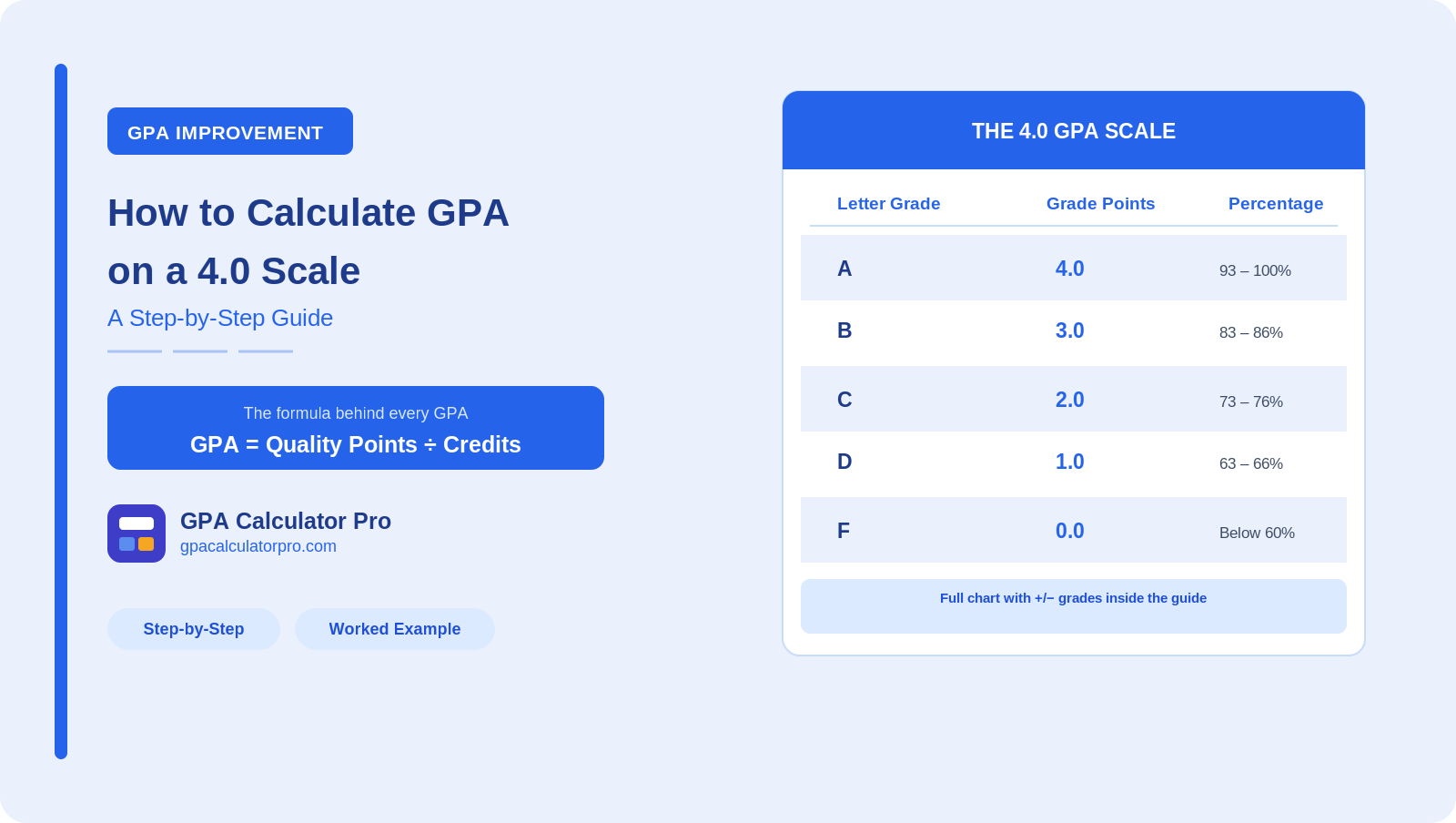
The 4.0 scale is the standard almost every US school, college, and university uses to report GPA, but most students have never actually worked through the math by hand. Understanding it takes the mystery out of your transcript and makes it much easier to spot an error, project a future grade, or convert from a different grading system. This guide walks through exactly how it works, step by step, with full worked examples.
What Is the 4.0 Scale?
The 4.0 scale converts letter grades into numeric "grade points," where a perfect A equals 4.0 and an F equals 0.0. It became the dominant US grading standard because it gives colleges, employers, and scholarship committees a single, comparable number, regardless of how any individual school structures its own grading policy. Your GPA (Grade Point Average) is simply the average of those grade points, weighted by how many credit hours each course was worth.
The Standard 4.0 Scale Chart
Here is the standard conversion most US schools use, including plus/minus grades:
| Letter Grade | Grade Points | Typical Percentage |
|---|---|---|
| A / A+ | 4.0 | 93 – 100% |
| A− | 3.7 | 90 – 92% |
| B+ | 3.3 | 87 – 89% |
| B | 3.0 | 83 – 86% |
| B− | 2.7 | 80 – 82% |
| C+ | 2.3 | 77 – 79% |
| C | 2.0 | 73 – 76% |
| C− | 1.7 | 70 – 72% |
| D+ | 1.3 | 67 – 69% |
| D | 1.0 | 63 – 66% |
| D− | 0.7 | 60 – 62% |
| F | 0.0 | Below 60% |
Some schools use a simplified version without plus/minus grades (A=4.0, B=3.0, C=2.0, D=1.0, F=0.0), so check your school's official policy if you're not sure which version applies to you.
Step-by-Step: How to Calculate Your GPA by Hand
GPA is credit-weighted, meaning a 4-credit course affects your GPA more than a 1-credit course. Here's the exact process:
- Step 1 - List every course, its letter grade, and its credit hours.
- Step 2 - Convert each letter grade to grade points using the chart above.
- Step 3 - Multiply each course's grade points by its credit hours to get "quality points" for that course.
- Step 4 - Add up all the quality points across every course.
- Step 5 - Add up all the credit hours across every course.
- Step 6 - Divide total quality points by total credit hours. That result is your GPA.
| Course | Grade | Credits | Grade Points | Quality Points |
|---|---|---|---|---|
| English 101 | A | 3 | 4.0 | 12.0 |
| Statistics 201 | B+ | 4 | 3.3 | 13.2 |
| Psychology 101 | A− | 3 | 3.7 | 11.1 |
| Lab Science | C+ | 2 | 2.3 | 4.6 |
| TOTAL | - | 12 | - | 40.9 |
GPA = 40.9 ÷ 12 = 3.41
That's the entire calculation. Once you understand these six steps, you can verify any GPA report from your school, or use our GPA Calculator to run the same math instantly across any number of courses.
Converting Percentage Grades to the 4.0 Scale
If your school reports raw percentages instead of letter grades, convert each course individually using the chart above before averaging. Don't average the percentages first and convert at the end, since that skips the credit-weighting step and can produce a slightly different (incorrect) result.
What If Your School Uses a Different Scale?
Not every school uses a plain 4.0 maximum. A few common variations:
- 4.33 scale: Some colleges give an A+ a value of 4.33 instead of capping at 4.0. Check your registrar's official policy, since this affects your exact GPA if you've earned A+ grades.
- Weighted scales (4.5, 5.0): High schools often add bonus points for AP, IB, or Honors courses, allowing GPAs above 4.0. This is a different calculation from the standard unweighted scale, see our dedicated guide: How to Calculate Weighted GPA
- 10-point CGPA scale (used in India and elsewhere): A completely different system that isn't a variant of the 4.0 scale. See our CGPA to Percentage guide if this applies to you.
Common Mistakes When Calculating GPA by Hand
- Forgetting to weight by credit hours: Simply averaging your letter grade points (ignoring credits) gives every course equal weight, which is inaccurate the moment your credit loads differ between courses.
- Averaging semester GPAs instead of recalculating from scratch: If you already have GPAs from previous semesters, you cannot just average those numbers together unless every semester carried identical total credits. Always work from total quality points ÷ total credits across every semester combined.
- Using the wrong plus/minus values: Not every school uses the same plus/minus point values, so always confirm your school's specific chart before treating this guide's standard values as official.
- Including Pass/Fail or Withdrawal courses incorrectly: A Pass typically contributes credits but no grade points; a standard Withdrawal (W) is usually excluded from the GPA calculation entirely. Confirm your school's specific policy for these cases.