If you're searching for how to raise your GPA fast, you're probably not looking for a four-year improvement plan. You need results this semester, before a deadline, or before your academic standing gets worse. The honest first step is knowing what's actually achievable in your specific timeframe. This guide covers the realistic ceiling for your situation and the handful of moves that genuinely work fast, not the slow, compounding strategies covered in our broader How to Raise Your GPA - 7 Strategies guide.
First: Know Your Realistic Ceiling
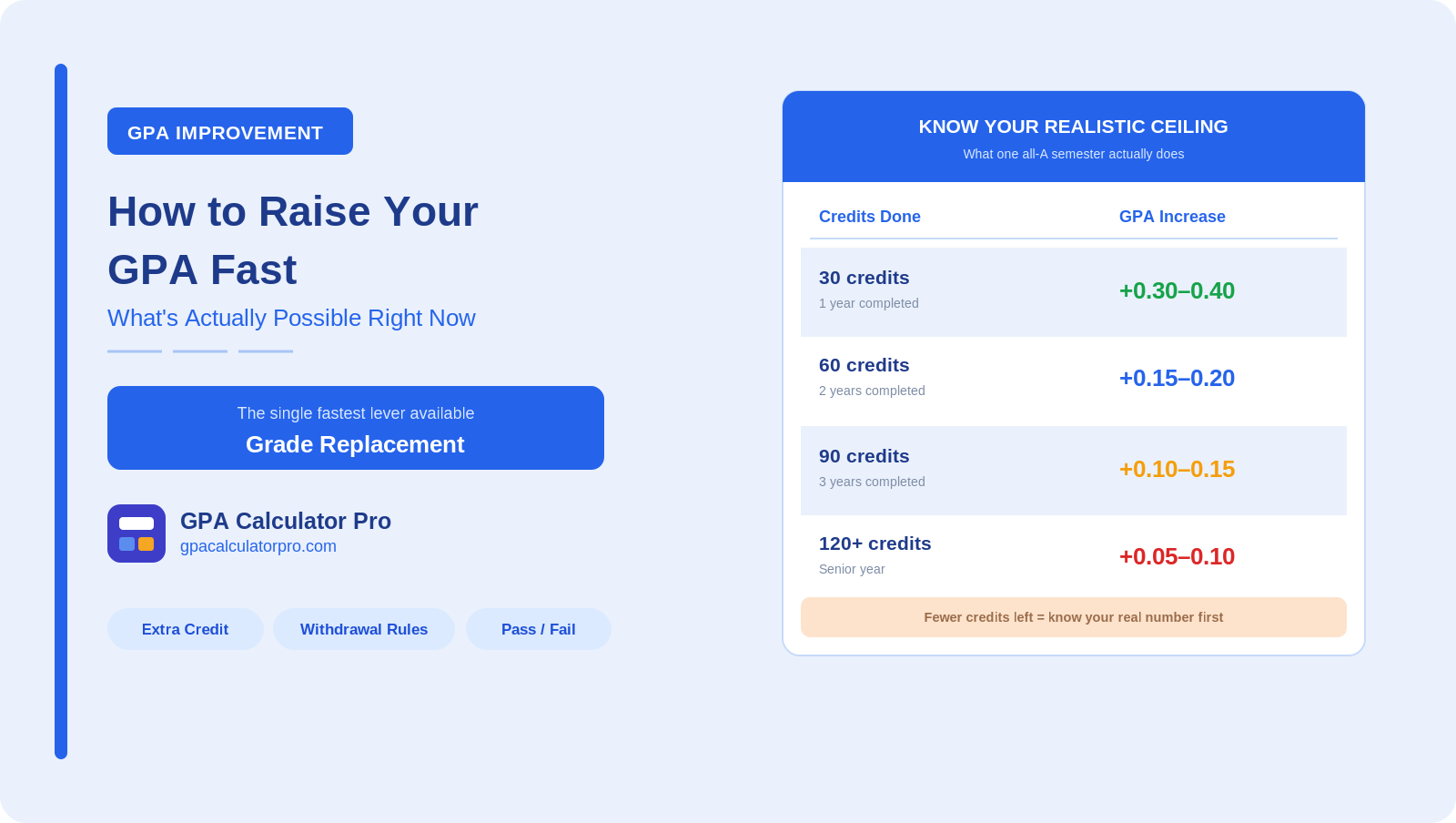
The single biggest factor in how fast your GPA can move is how many credits you've already completed. This isn't discouraging, it's the number that tells you what to actually expect, so you're not chasing an impossible target under pressure.
| Credits Completed | One All-A Semester Raises GPA By |
|---|---|
| 30 credits (1 year) | ~0.30 – 0.40 points |
| 60 credits (2 years) | ~0.15 – 0.20 points |
| 90 credits (3 years) | ~0.10 – 0.15 points |
| 120+ credits (senior year) | ~0.05 – 0.10 points |
Enter your exact numbers into our Cumulative GPA Calculator to see precisely where a strong semester would actually land you. Knowing the real number changes how you spend the next few weeks.
The Fastest Levers That Actually Move the Number
1. Grade Replacement - the Single Biggest Lever Available
If your school allows retaking a course and replacing the original grade, this is by far the fastest way to recover lost GPA points. A single F replaced by a B in a 3-credit course can add roughly 9 quality points, more impact than almost anything else on this list. Confirm your school's specific policy with the registrar before assuming it applies.
2. Know Exactly What You Need on Remaining Finals
Before you study another hour, calculate precisely what score you need on each remaining final to hit your target grade in that course. Use our Final Grade Calculator for every class. This alone often reveals that some courses need far less effort than you assumed, freeing up time for the ones that actually matter.
3. Ask About Extra Credit - Before It's Too Late
Many professors offer extra credit opportunities that aren't advertised unless a student asks directly, especially in the final two weeks of a term. A few extra percentage points on a borderline course can be the difference between a full letter grade.
4. Use Pass/Fail Strategically on Struggling Electives
If you're at risk of a low grade in an elective outside your major, and your school allows a late Pass/Fail election, this protects your GPA entirely. A Pass earns credit with zero GPA impact. Confirm your school's election deadline; many are earlier in the semester than students expect.
5. Withdraw Before the Deadline - Don't Let It Become an F
A standard withdrawal (W) has no GPA impact at all. If a course is heading toward a D or F and the withdrawal deadline hasn't passed, withdrawing protects your GPA completely. Missing that deadline often means an automatic WF, which counts as an F. Mark your school's specific date now, not later.
Scenario: You Have One Semester Left
With limited time remaining, prioritize your highest-credit courses first. A 4-credit course moves your GPA twice as much as a 2-credit course carrying the same grade change. Run the Final Grade Calculator on every remaining class, then concentrate your remaining study hours on the courses where the math shows the biggest realistic swing.
Scenario: You're on Academic Probation
Academic probation typically comes with a specific GPA target and a deadline, usually the following semester. Use our GPA Planning Calculator to model exactly what grades you need this term to clear probation, and talk to your academic advisor about course load. Taking on too much while trying to recover often backfires. A lighter, focused course load with strong grades usually outperforms a full load with mixed results.
Scenario: One Bad Class Is Dragging Everything Down
If a single low grade is the main issue, isolate it: check whether grade replacement applies, whether withdrawal is still possible, or whether the professor offers a path to improve it (extra credit, a final project, an incomplete with a plan to finish). Don't let one class consume all your attention if the other option, pulling A's in your other courses, would offset it faster.
What Doesn't Work
- Taking easier courses just to pad your GPA: If your remaining credit load is small, the impact is minimal, and it can raise questions if your major requires specific coursework you're avoiding.
- Retaking a course where grade averaging (not replacement) applies: If your school averages both attempts instead of replacing the grade, retaking a course helps far less than students expect. Confirm your school's specific policy first.
- Ignoring the withdrawal deadline until it's already passed: Once the deadline passes, the option is gone for that semester. There is no fast fix for a missed deadline.