"Is my GPA good?" means something different depending on whether you're a freshman just starting out or a senior finalizing college applications. A 3.2 is a strong start in 9th grade and a limiting number by 12th. This guide breaks down exactly what counts as good at every stage - by specific number, by grade level, and by what it actually opens for you.
Quick Reference - GPA Ranges in High School
On the standard unweighted 4.0 scale, here's how each range is generally viewed by colleges and scholarship committees:
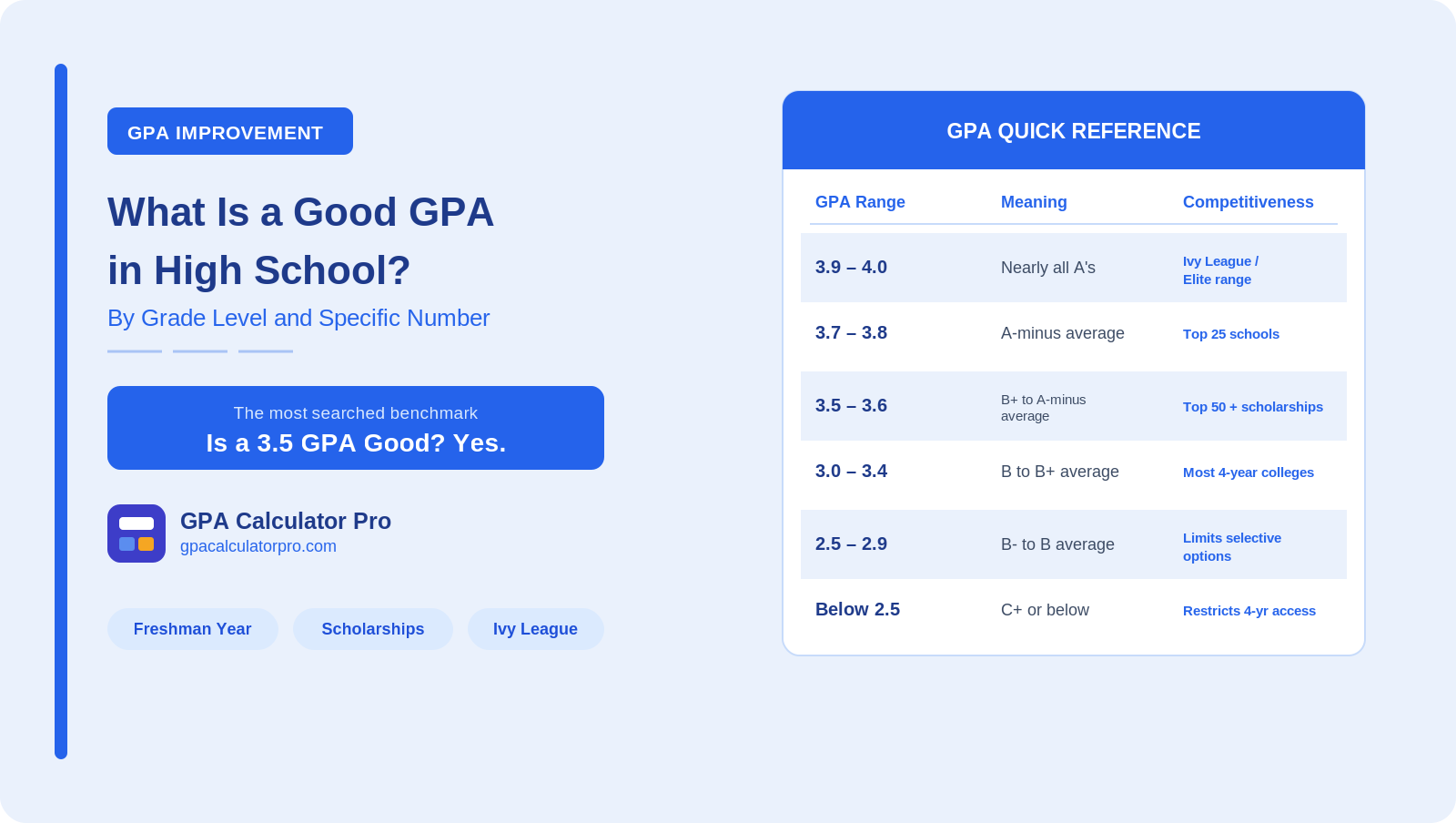
| GPA Range | What It Means | College Competitiveness |
|---|---|---|
| 3.9 – 4.0 | Nearly all A's | Ivy League and elite university range |
| 3.7 – 3.8 | A-minus average | Competitive for top 25 universities |
| 3.5 – 3.6 | B+ to A-minus average | Strong for top 50 schools and most scholarships |
| 3.0 – 3.4 | B to B+ average | Solid for the majority of 4-year colleges |
| 2.5 – 2.9 | B-minus to B average | Limits options at selective schools |
| Below 2.5 | C+ average or below | Restricts access to most 4-year universities |
Use our High School GPA Calculator to calculate both your weighted and unweighted GPA precisely - the number that matters for this comparison is your unweighted GPA.
Is a 2.5 GPA Good in High School?
A 2.5 GPA is below average and will limit your options at most 4-year colleges. It's not disqualifying - many schools with open or moderately selective admissions still accept students in this range - but it removes access to selective universities and most merit scholarships, which typically start at 3.5. If you're a freshman or sophomore at 2.5, there's real time to move it before applications matter.
Is a 3.0 GPA Good in High School?
Yes - a 3.0 GPA is a solid, average-to-good standing and meets the baseline for the majority of 4-year colleges. It represents a straight B average. It won't be competitive at selective or Ivy League schools, but it's not a limiting number for most college paths, and it typically qualifies for state school admission and many merit-based programs with lower thresholds.
Is a 3.5 GPA Good in High School?
Yes - a 3.5 GPA is very good and opens most doors. It qualifies for the majority of scholarship programs (3.5 is the most common merit scholarship threshold), is competitive for top-50 universities, and represents a B+ to A-minus average. For elite schools (top 20), you'd want to be closer to 3.8+, but 3.5 is genuinely strong for the vast majority of college goals.
Is a 3.8 GPA Good in High School?
Yes - a 3.8 GPA is excellent and competitive even at highly selective universities. It places you in the top tier of most graduating classes and is within range for top-25 schools. At the most elite level (Ivy League, MIT, Stanford), the median admitted GPA is closer to 3.9+ unweighted, so a 3.8 is strong but benefits from course rigor and other application factors to stand out at that specific tier.
Is a 4.0 GPA - or Higher - Good in High School?
A 4.0 unweighted GPA means straight A's across every course - it's rare to sustain across four full years and represents the top of the scale. If your school reports a weighted GPA above 4.0 (common with AP/Honors bonus points), that's a different number entirely - see the section below on which one "good" actually refers to.
What's a Good GPA by Grade Level?
A single target number matters less than your trajectory. Colleges read your transcript year by year, not just the final average - an upward trend is viewed favorably even when the cumulative number is moderate.
| Grade | What Matters Most | A Strong Benchmark |
|---|---|---|
| Freshman (9th) | Establishing habits; grades count toward cumulative GPA from day one | 3.3+ |
| Sophomore (10th) | Course rigor typically increases; consistency matters | 3.4+ |
| Junior (11th) | The most heavily weighted year for college applications | 3.5+ |
| Senior (12th, 1st sem.) | Colleges see this before final decisions; don't coast | Maintain or improve |
If your early grades were weaker, a clear upward trend from freshman to junior year is one of the most positively read patterns in a college application - more so than the same cumulative GPA held flat across all four years.
Weighted vs. Unweighted - Which One Is "Good" Referring To?
This matters more than most students realize. Unweighted GPA caps at 4.0 and treats every course equally. Weighted GPA adds bonus points for AP, IB, and Honors courses, allowing GPAs above 4.0 - sometimes up to 5.0.
When people ask "is a 3.8 GPA good," they're almost always asking about the unweighted number, since that's what colleges use as the primary comparison metric across applicants from different high schools. Your weighted GPA is supporting context that shows course rigor - valuable, but secondary. Use our High School GPA Calculator to see both numbers side by side.
What's a Good GPA for Your Specific Goal?
| Goal | GPA You Need | Notes |
|---|---|---|
| Avoid academic concern | 2.0 minimum | Most schools flag below this |
| Dean's List / Honor Roll | 3.5+ (semester) | Threshold varies by school - confirm yours |
| Most 4-year colleges | 3.0+ | Broad range of schools accept this comfortably |
| Merit scholarships | 3.5+ | Most common threshold; some require 3.7+ |
| Top-50 universities | 3.5 – 3.7 | Course rigor matters alongside the number |
| Top-25 universities | 3.7 – 3.9 | Increasingly competitive; rigor and test scores matter more |
| Ivy League / elite schools | 3.9+ | Median admitted GPA; GPA alone doesn't guarantee admission |