"What is a good GPA?" is one of the most searched academic questions online - and one of the least helpfully answered. Most responses give you a generic number without context. A 3.5 is excellent for some situations and merely average for others. The honest answer depends entirely on what you are using the GPA for.
This guide breaks it down by situation - high school, college, grad school, medical school, and employers - so you know exactly what your GPA means for your specific goal.
What Is a GPA?
A GPA (Grade Point Average) is a single number on the 0.0 to 4.0 scale that summarizes your academic performance across all courses. Each letter grade converts to grade points: A = 4.0, B = 3.0, C = 2.0, D = 1.0, F = 0.0. Those points are weighted by credit hours and averaged to produce your GPA.
There are two versions: unweighted GPA uses the standard 4.0 scale for every course. Weighted GPA adds bonus points for AP, IB, and Honors courses, allowing GPAs above 4.0. For most purposes - college admissions, grad school, employment - the unweighted 4.0 scale is the standard reference.
To calculate your exact GPA right now, use our College GPA Calculator for college courses or our High School GPA Calculator for high school. Both give you your precise number on the 4.0 scale instantly.
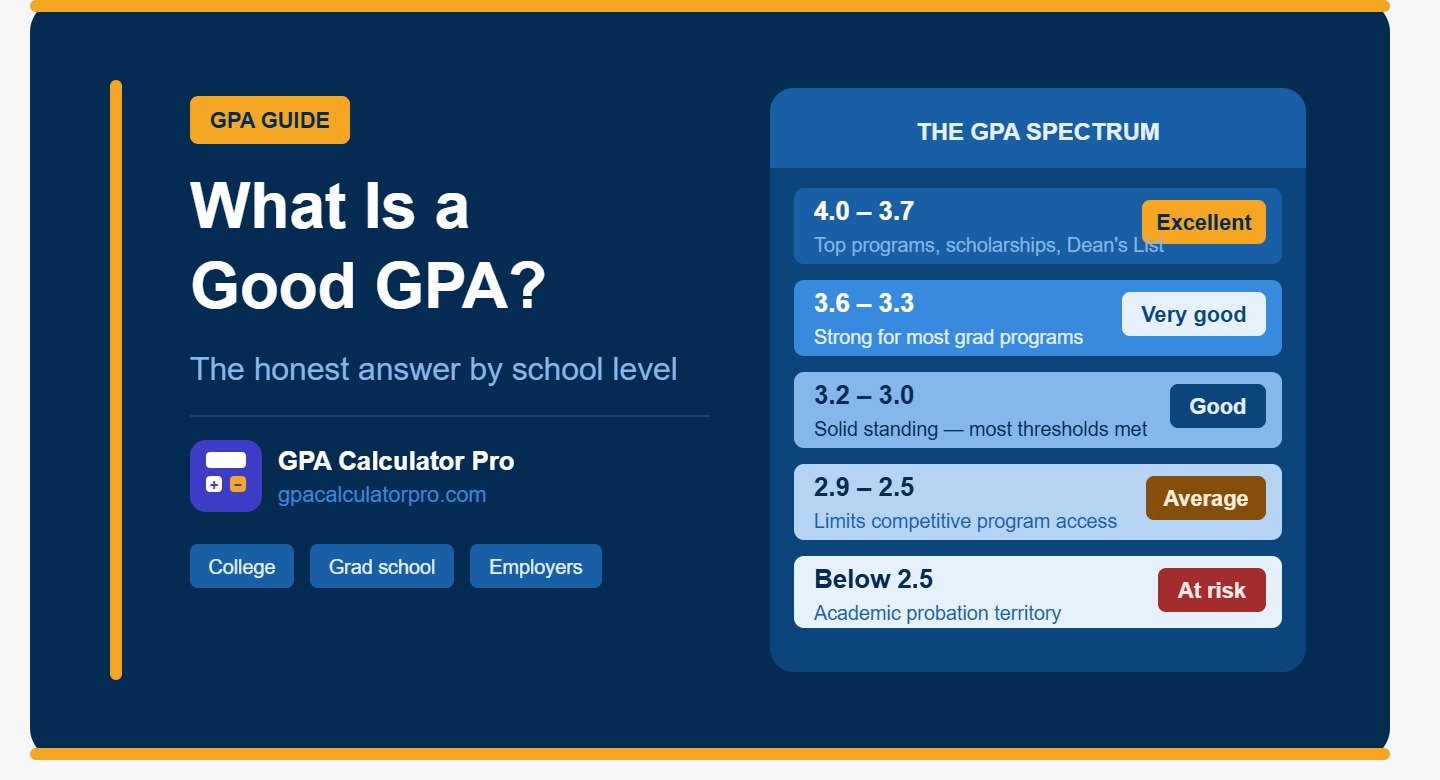
GPA Scale - What Each Number Actually Means
| GPA | Letter Equivalent | What It Reflects |
|---|---|---|
| 4.0 | Straight A's | Perfect - extremely rare sustained over a full degree |
| 3.7 – 3.9 | A to A− average | Excellent - consistently strong across all subjects |
| 3.3 – 3.6 | B+ to A− average | Very good - above average, competitive for most programs |
| 3.0 – 3.2 | B to B+ average | Good - solid academic standing, meets most thresholds |
| 2.7 – 2.9 | B− to B average | Above average - may limit access to competitive programs |
| 2.5 – 2.6 | C+ to B− average | Average - meets basic requirements, limits selective options |
| 2.0 – 2.4 | C average | Below average - minimum for most graduation requirements |
| Below 2.0 | C− and below | Academic risk - probation threshold at most institutions |
What Is a Good GPA for High School?
High school GPA matters for two things: college admissions and scholarship eligibility. The threshold for "good" shifts dramatically depending on which colleges you are targeting.
| GPA Range | College Options It Opens | Notes |
|---|---|---|
| 3.9 – 4.0 | Ivy League and elite universities | Average admitted GPA at Harvard, Stanford, MIT is 3.9+ unweighted |
| 3.7 – 3.8 | Top 25 universities | Very competitive - strong for most selective schools |
| 3.5 – 3.6 | Top 50 universities, merit scholarships | Competitive for most strong programs; qualifies for many scholarships |
| 3.0 – 3.4 | Most 4-year colleges | Solid for the majority of U.S. universities |
| 2.5 – 2.9 | Less selective schools | Limits options at selective institutions |
| Below 2.5 | Community college, some open-enrollment schools | Many 4-year universities require at least 2.5 for admission |
Weighted vs unweighted: colleges receive your unweighted GPA on your official transcript and use it for direct comparison across applicants. Weighted GPA is secondary context - it shows course rigor. A 3.7 unweighted with AP courses reads better than a 3.7 unweighted with all regular classes, even though the number is the same.
What Is a Good GPA in College?
College GPA benchmarks are used for four main things: academic standing, internships, graduate school, and employment. Each has different thresholds.
Academic Standing
- 2.0 minimum: required to avoid academic probation at most U.S. colleges
- 2.5–3.0: required to stay in many competitive programs (nursing, engineering, business)
- 3.5+: Dean's List at most institutions - threshold varies but 3.5 is the most common standard
Internships and Entry-Level Jobs
- 3.0: the baseline threshold most employers state on applications. Below 3.0 will filter you out of many large company application portals automatically
- 3.5+: competitive for finance, consulting, Big 4 accounting, and government roles
- 3.7+: expected for highly competitive employers (investment banking, top consulting, federal honours programs)
What Is a Good GPA for Grad School?
| Program Type | Typical Minimum GPA | Competitive GPA |
|---|---|---|
| Master's programs (general) | 3.0 | 3.3 – 3.5 |
| PhD programs | 3.3 | 3.5 – 3.8 |
| MBA (top programs) | 3.3 | 3.5 – 3.7 |
| Law school (top 14) | 3.5 | 3.7 – 3.9 |
| Medical school | 3.5 | 3.7 – 3.9 (science GPA matters separately) |
| Dental school | 3.2 | 3.5 – 3.7 |
| Pharmacy school | 3.0 | 3.2 – 3.5 |
For graduate school, your major GPA or science GPA often carries more weight than your overall cumulative GPA. A 3.3 overall with a 3.8 in your major is a stronger application to a relevant program than a 3.5 overall with a 3.2 in the field.
Is a 3.0 GPA Good?
Yes - a 3.0 GPA is the standard baseline for "good standing" in college. It represents a straight B average and meets the minimum threshold for most graduate school applications, employer screening systems, and program continuation requirements.
What a 3.0 does well: keeps you off academic probation, qualifies you for most entry-level job applications, and meets the minimum for most master's programs. What it limits: highly competitive grad programs (law, medicine, top MBA), finance and consulting firms with 3.5+ cutoffs, and merit-based scholarships.
If you are at 3.0 and want to raise it, use our Cumulative GPA Calculator to see your exact current position, then our GPA Planning Calculator to model what grades you need each semester to reach your target.
Is a 3.5 GPA Good?
A 3.5 GPA is very good by virtually any standard. It sits solidly in the top 25–30% of students at most institutions, qualifies for Dean's List at the majority of U.S. colleges, meets or exceeds the stated minimum for most graduate programs, and makes you competitive for most employer screening thresholds.
What a 3.5 opens: most scholarship applications, most graduate programs including competitive ones, most employer application portals, and Dean's List recognition. What it may not be enough for: top-5 law schools (median is 3.8+), medical school at elite institutions (median is 3.7+ with a 3.7+ science GPA), and bulge-bracket investment banking at target schools.
Is a 3.7 GPA Good?
A 3.7 GPA is excellent. It represents an A-minus average - sustained strong performance across subjects including the harder ones. A 3.7 is competitive for virtually all graduate programs, most scholarship competitions, and puts you in strong position for selective employer screening.
At most schools, a 3.7 places you in the top 10–15% of your class. For reference: the median admitted GPA at top-20 law schools is 3.7–3.9. For medical school, 3.7+ overall with 3.7+ science GPA is the realistic floor for competitive programs. For investment banking and top consulting, 3.7 is what recruiters want to see.
What Is a Good GPA for Specific Goals?
| Your Goal | GPA You Need | What Else Matters |
|---|---|---|
| Good academic standing | 2.0 minimum | Meeting major-specific GPA requirements (often higher) |
| Dean's List | 3.5 (semester GPA) | Full-time enrollment, no grades below C at some schools |
| Most scholarships | 3.5 cumulative | Some require 3.7+; athletic scholarships start at 2.0 NCAA floor |
| Entry-level jobs (most industries) | 3.0 | Internship experience matters more than GPA after first year |
| Finance / consulting / Big 4 | 3.5 – 3.7 | Target school recruitment matters as much as GPA |
| Master's programs | 3.0 minimum, 3.3+ competitive | Research experience, recommendations, GRE/GMAT scores |
| PhD programs | 3.3 minimum, 3.5+ competitive | Research output, publications, professor relationships |
| Law school (top 14) | 3.7+ unweighted | LSAT score is equally or more determinative than GPA |
| Medical school (competitive) | 3.7+ overall + 3.7+ science | MCAT score, research, clinical hours, letters |
| MBA (top 10 programs) | 3.5 – 3.7 | Work experience, GMAT/GRE, leadership story |
Does GPA Matter After Graduation?
For the first job: yes, significantly for competitive employers. Most large company application portals screen by GPA cutoff before a human sees your resume. Getting past that filter matters.
After 2–3 years of work experience: GPA weight drops sharply. Employers care far more about what you have done professionally than what you earned academically. Most job postings stop asking for GPA after the entry-level stage.
Exceptions where GPA matters long-term: graduate school applications (always), professional school (law, medicine, dentistry), government security clearances (sometimes), and some professional certifications. If any of these are in your future, your undergraduate GPA stays relevant.
How to Improve Your GPA From Where You Are
- Know your exact number first. Many students are guessing. Enter your actual grades and credits into the calculator - knowing the precise number makes the goal concrete.
- Identify your highest-impact target. A C raised to a B in a 4-credit course moves your GPA more than marginal improvements across five 1-credit courses. Target the heaviest courses where you have the most room to improve.
- Use grade replacement if available. If your school allows retaking a course with the new grade replacing the old one, a single F replaced by a B can add significant quality points to your cumulative total.
- Model your path before committing. Use the GPA Planning Calculator to see exactly how many semesters of what grades are needed to reach your target. Most students are surprised - either it is more achievable than they thought, or they have been targeting the wrong timeline.
- Know what you need on each final. Before finals week, calculate the exact score you need in each course to hit your target grade. Spending study hours on a grade that is mathematically unreachable is one of the most common GPA mistakes.