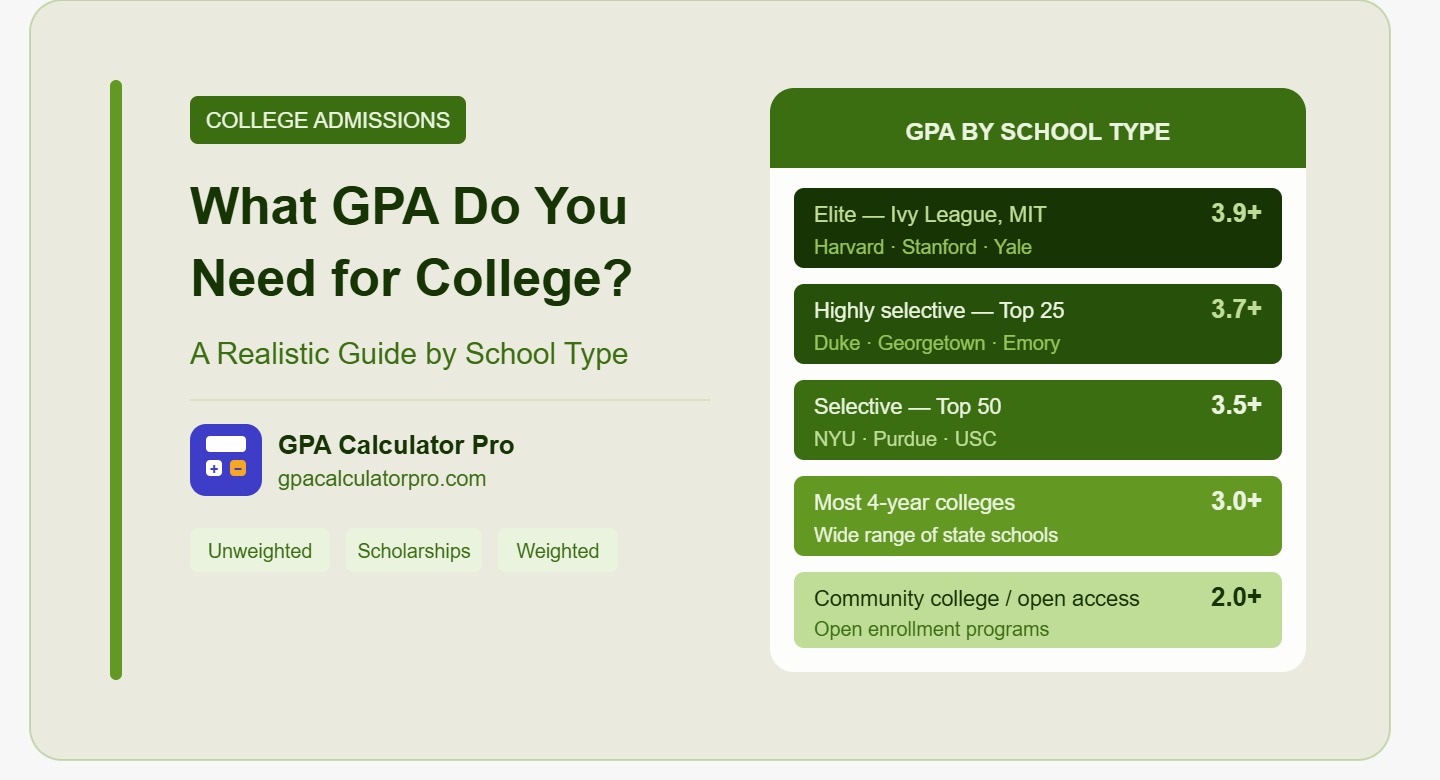
There is no single GPA required to get into college. The number that matters depends entirely on where you're applying - a 2.5 is competitive at many schools and disqualifying at others. This guide breaks it down honestly, by school type, so you know exactly what you're working with.
GPA Requirements by College Selectivity Tier
| School Type | Typical GPA Range | Notes |
|---|---|---|
| Open Enrollment / Community College | No minimum | Most accept all applicants with a high school diploma or GED |
| Less Selective 4-Year | 2.0 – 2.5+ | Many state schools and private colleges in this tier accept a wide range |
| Moderately Selective 4-Year | 2.5 – 3.2 | Competitive applicants typically above 3.0; below 2.5 requires strong other factors |
| Selective 4-Year | 3.3 – 3.7 | Most applicants admitted above 3.5; below 3.0 is difficult without exceptional factors |
| Highly Selective (Top 50) | 3.7 – 4.0 unweighted | Average admitted GPA often 3.8+; some flexibility for recruited athletes, first-gen, legacy |
| Ivy League / Elite | 3.9 – 4.0 unweighted | Median admitted GPA 3.9+; GPA alone doesn't guarantee admission even at this level |
What GPA Do You Need for a Scholarship?
Scholarship GPA minimums are typically higher than admission minimums because scholarships are merit-based, not just access-based.
| Scholarship Type | Typical Minimum GPA |
|---|---|
| Institutional merit scholarships (most colleges) | 3.0 – 3.5 |
| Competitive institutional scholarships | 3.5 – 3.8 |
| State merit programs (HOPE, Bright Futures, etc.) | 3.0 – 3.7 (varies by state) |
| National merit / highly competitive programs | 3.8+ |
| Athletic scholarships | 2.0 NCAA minimum; team standards often 2.5–3.0 |
| Federal aid (Pell Grant, loans) | Satisfactory Academic Progress - typically 2.0+ cumulative |
Does Weighted or Unweighted GPA Matter More for College?
For admissions: unweighted GPA is the primary number. Weighted GPA is supporting context - it shows you challenged yourself with rigorous coursework, which admissions offices value. But a 4.2 weighted GPA with mostly Regular classes is less impressive than a 3.8 weighted GPA built on AP and Honors courses.
For college applications, what matters alongside GPA:
Course Rigor
Did you take the hardest courses available to you? A 3.5 in AP classes reads very differently than a 3.5 in all Regular classes. Admissions officers factor in the strength of your curriculum when evaluating your GPA.
Grade Trend
Improving from sophomore to junior to senior year signals maturity and determination. A declining trend concerns admissions officers. An upward arc in your transcript can contextualize a shaky start.
Class Rank
At schools that report it, where you stand relative to your classmates matters. A 3.4 GPA at a school with grade deflation may outperform a 3.7 at a school with relaxed grading - admissions offices know this.
SAT / ACT Scores
At test-optional schools, a strong GPA can compensate for the absence of scores. At test-required schools, strong scores can offset a borderline GPA. The two numbers work together, not independently.
What If Your GPA Falls Short of Your Target School's Range?
If your GPA is below the range for schools you want, you have real options - and some of them are more effective than students realize:
- Apply anyway if you're within 0.2–0.3 of the average. GPA ranges are averages, not cutoffs. Strong essays, recommendations, and demonstrated interest can bridge a gap, especially at schools that take a holistic view.
- Explain a grade trend upward. If your freshman GPA was 2.7 but you've pulled it to 3.2 by junior year, that trajectory matters and belongs in your application narrative.
- Target the right school mix. Apply to safety, match, and reach schools across the selectivity tiers above - don't build a list entirely of schools where your GPA is below average.
- Community college transfer pathway. Many selective 4-year universities have transfer agreements with community colleges. A strong 2-year GPA (typically 3.0+) can open doors that a high school GPA couldn't.
- Raise it before you apply. If you're a junior with time, every semester matters. Use our GPA Planning Calculator to see exactly what grades you need this year to hit your target before applications go out.
The GPA Number That Matters Most: Cumulative, All Four Years
Colleges receive your cumulative GPA across all four high school years on your official transcript. Freshman grades count - there's no automatic forgiveness for a rough 9th grade, though a strong upward trend can contextualize it.
Check your current cumulative high school GPA using our High School GPA Calculator. If it's lower than you need, the GPA Planning Calculator shows you exactly what senior year grades would move the number - so you can walk into applications knowing your actual position, not guessing.
Calculate My High School GPA