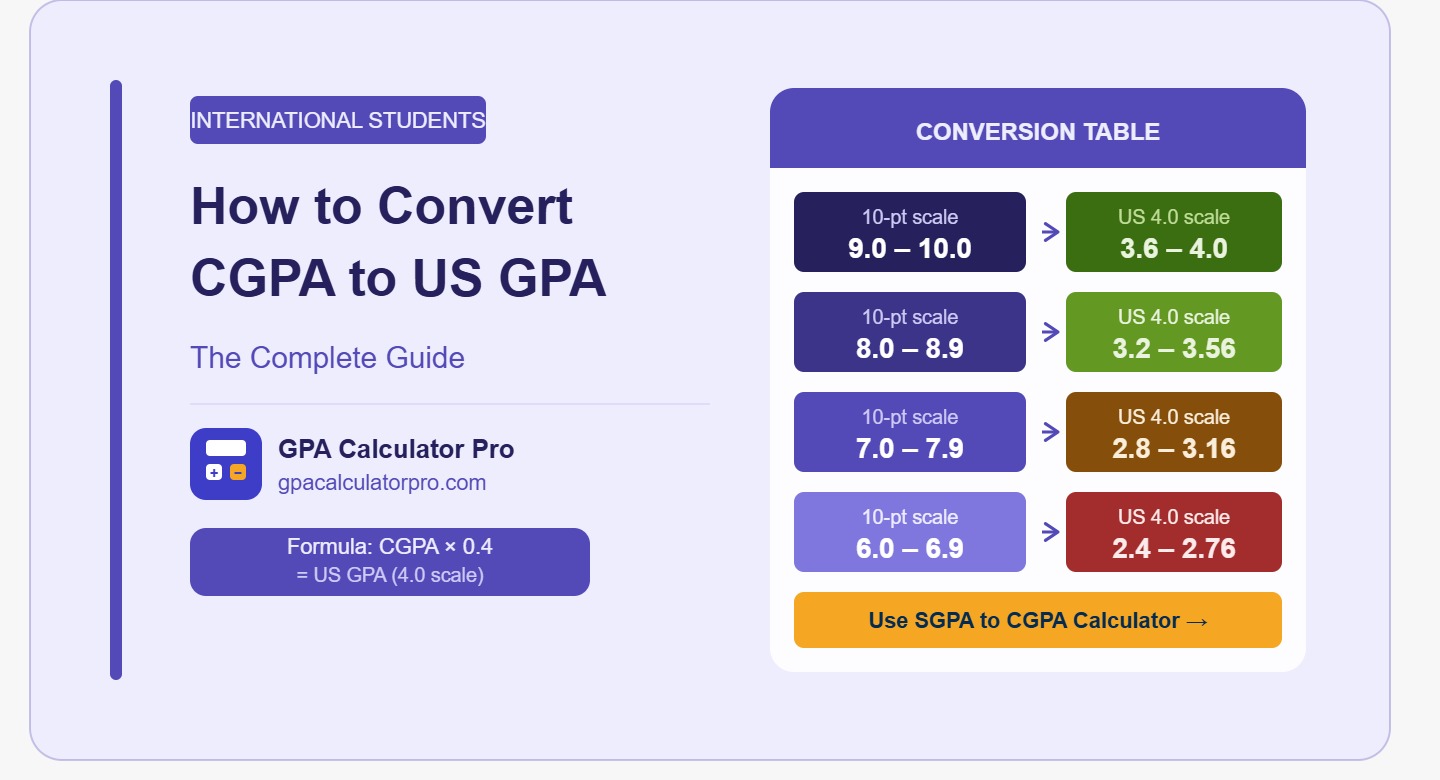
If you completed your undergraduate degree in India or another country that uses a 10-point CGPA scale, and you're applying to US graduate programs, you'll face one immediate question from every application form: "GPA on a 4.0 scale." Your CGPA doesn't fit that box directly.
This guide walks you through every method - the simple formula, the WES approach, university-specific guidelines, and when to let your institution do the conversion for you.
Why US Universities Need a Converted GPA
American universities almost exclusively use the 4.0 GPA scale. Admissions committees are trained to read this scale - they know that a 3.7 is strong, a 3.0 is average, and below 2.5 raises flags. When your transcript arrives showing a 7.8 or 8.4 out of 10, the committee has no quick frame of reference.
Converting gives them - and you - a shared language. It also lets you compare yourself honestly to domestic applicants competing for the same spots.
Method 1 - The Simple Proportional Formula
This is the fastest conversion and is accepted by many universities as a self-reported estimate on applications.
Examples using a 10-point scale:
| CGPA (10-point scale) | US GPA (4.0 scale) | Letter Grade | Standing |
|---|---|---|---|
| 9.5 – 10.0 | 3.8 – 4.0 | A / A+ | Excellent |
| 9.0 – 9.4 | 3.6 – 3.76 | A | Excellent |
| 8.5 – 8.9 | 3.4 – 3.56 | A− | Very Good |
| 8.0 – 8.4 | 3.2 – 3.36 | B+ | Good |
| 7.5 – 7.9 | 3.0 – 3.16 | B | Good |
| 7.0 – 7.4 | 2.8 – 2.96 | B− | Above Average |
| 6.5 – 6.9 | 2.6 – 2.76 | C+ | Average |
| 6.0 – 6.4 | 2.4 – 2.56 | C | Average |
| Below 6.0 | Below 2.4 | D / F | Below Average |
Method 2 - WES (World Education Services) Evaluation
WES is the gold standard for international credential evaluation in the US and Canada. Many top graduate programs - especially Ivy League and research universities - require a WES evaluation rather than a self-reported conversion.
Create a WES account
Go to wes.org and create a free account. Choose "WES ICAP" if you need the evaluation for graduate school.
Request official transcripts
Your university registrar must send sealed, official transcripts directly to WES. Photocopies are not accepted.
Pay the evaluation fee
A course-by-course evaluation (required for graduate school) costs approximately $160–$225 USD and takes 7–10 business days.
Receive your US GPA
WES converts your grades course-by-course using their proprietary rubric and issues an official US-equivalent GPA on the 4.0 scale.
WES conversions are often more favourable than the simple formula because they look at each subject grade individually rather than applying a blanket percentage multiplier.
Method 3 - University-Specific Guidelines
Some universities publish their own conversion charts. Always check the graduate admissions page of each school you're applying to. Common university-specific rules include:
- MIT: Uses WES or equivalent evaluation - self-reported conversions are noted but not official.
- Stanford: Accepts self-reported GPA on the application; an official evaluation is submitted if admitted.
- Georgia Tech: Publishes explicit conversion tables for Indian, Chinese, and European grading systems on their graduate admissions page.
- Carnegie Mellon: Accepts the proportional formula for the application; WES is required only post-offer.
Indian University Grading Systems - Special Cases
India alone has multiple grading systems depending on the university, board, and year of graduation:
| System | Scale | Conversion Formula |
|---|---|---|
| CGPA (most central universities) | 10-point | (CGPA / 10) × 4 |
| Percentage (older transcripts) | 0–100% | (Percentage / 100) × 4 |
| Grade Points (IIT, NIT) | 10-point (CPI/SPI) | (CPI / 10) × 4 |
| Division system (old) | First / Second / Pass | First Div ≈ 3.2–3.6 (case-by-case) |
What to Write on Your Application
Most US graduate applications (through GradCafe, university portals, or the Common App) will ask for:
- GPA: Enter your converted value (e.g., 3.4)
- Scale: Enter 4.0 (since you're converting to the 4.0 scale)
- Original GPA/CGPA: Enter your actual CGPA (e.g., 8.5) and the original scale (10)
Always fill in both fields when given the option. Admissions officers appreciate transparency and are very familiar with international applicants filling in both the original and converted scores.
Does a Converted GPA Hold the Same Weight?
Yes and no. Admissions committees at top research universities are well-trained in reading international transcripts. A converted GPA is a helpful reference point, but they also look at:
- The reputation and ranking of your undergraduate institution
- The grading curve at your university (some universities are notoriously strict)
- Your GRE or GMAT scores as a standardised counterpoint
- Your Letters of Recommendation from professors who can contextualise your academic performance
A 3.2 converted GPA from an IIT with a strong GRE score and excellent letters will outperform a 3.8 from an unknown institution in most admissions decisions.
Use Our Free CGPA Converter
You can instantly convert your CGPA to a US GPA using our free SGPA to CGPA calculator, which also supports 10-point to 4.0-scale conversions.
Convert My CGPA Now