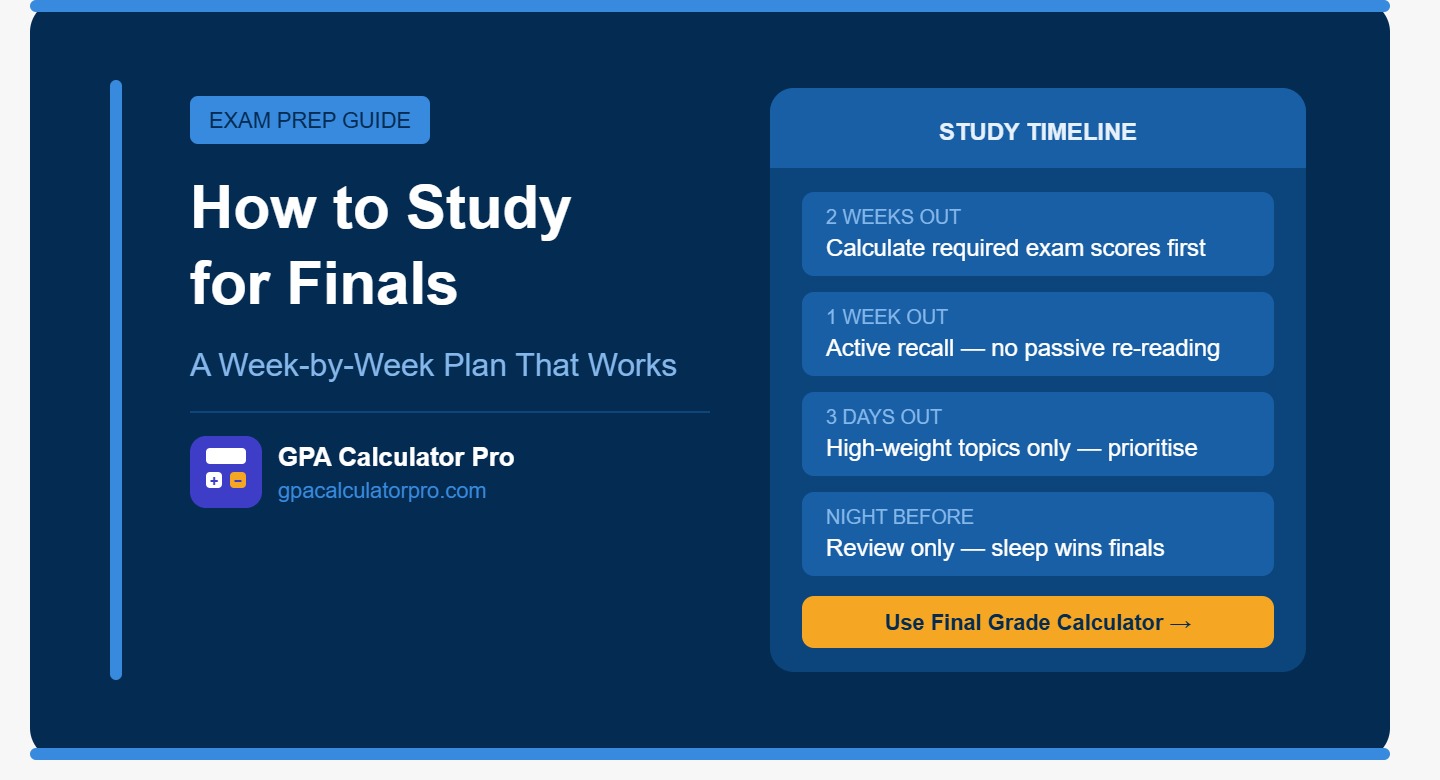
Most students approach finals the same way every semester: panic sets in around Day 3, they try to study everything at once, and they walk into exams without a clear target. The students who consistently outperform them don't study harder - they study with a plan.
This guide gives you that plan. Starting two weeks out, through the night before.
Before you open a single textbook, run the numbers
The most important thing you can do before finals week is calculate exactly what score you need in each course. This does two things: it tells you where to focus your study time, and it eliminates the anxiety of not knowing what's at stake.
Use our Final Grade Calculator - enter your current grade, your target grade, and the weight of the final exam. It gives you the exact score you need.
Real example: You have a 79% in Biology. You want a B (80%). Your final is worth 30%.
Required score = (80 − 79 × 0.70) ÷ 0.30 = (80 − 55.3) ÷ 0.30 = 82.3%.
Totally achievable with solid preparation. Now you know your target - study to 83%, not perfection.
Run this calculation for every course. You'll quickly see which exams are high-stakes (where you need 85%+), which are comfortable (under 70% needed), and which are already locked in. Allocate your study hours accordingly.
Build your study priority list
Not all finals deserve equal time. Once you know your required scores, rank your courses:
| Required Score | Priority Level |
|---|---|
| 0% or negative | Locked - minimal review only |
| 1%–69% | Low - light review, don't over-invest |
| 70%–84% | Medium - solid study block needed |
| 85%–94% | High - this exam matters, plan serious prep |
| 95%–100% | Critical - near-perfect needed, maximum focus |
| Above 100% | Redirect - target lower grade, study accordingly |
Two Weeks Out - Build Your Schedule
Two weeks is the minimum for effective finals preparation. Start here:
- List every final: date, time, location, weight, required score
- Identify your 2 hardest exams: these get the most days, spread furthest from the exam date
- Block study sessions: 90-minute blocks with 15-minute breaks work better than marathon sessions. Schedule 2–3 blocks per day maximum
- Assign topics to sessions: don't just plan "study Bio" - plan "review Chapter 8 cell division, do practice problems 1–20"
- Leave buffer days: at least one day before each exam with no new material - only review
One Week Out - The Active Recall Method
Passive review (re-reading notes, re-watching lectures) feels productive but retains little. Active recall - forcing yourself to retrieve information without looking - doubles retention compared to passive review. Here's how to do it:
- Flashcards: write the question on one side, answer on the other. Test yourself, flag the ones you miss, retry only the missed ones
- Blank page recall: close your notes, write down everything you can remember about a topic, then check what you missed
- Practice problems: especially for math, science, and accounting - do the problems without looking at examples first
- Teach it out loud: explaining a concept to an imaginary student (or a real one) surfaces gaps in your understanding faster than any other method
Three Days Out - Topic Prioritization
By now, you should be past broad review and into targeted practice. The 80/20 rule applies hard here: roughly 20% of the content generates 80% of the exam questions. Identify the high-weight topics by:
- Checking which topics your professor emphasized most in class
- Looking at how many practice problem sets exist for each section - more sets = higher exam weight
- Reviewing any provided study guides or learning objectives - these are not subtle hints, they're the exam outline
Spend the bulk of your study time in these three days on the high-frequency topics. If you run out of time, drop the low-frequency ones first.
The Night Before - What Not to Do
The night before a final is not a study session - it's a consolidation session. Your brain solidifies memories during sleep. Trading sleep for three more hours of review is one of the worst academic trades you can make.
✅ Do
- Review your most important one-page summary of key concepts
- Confirm your exam time, location, and what you're allowed to bring
- Prepare everything the night before - pencils, calculator, ID, water
- Get 7–8 hours of sleep
🚫 Don't
- Learn new material
- Stay up past midnight if your exam is in the morning
- Study with people who increase your anxiety rather than focus
- Skip meals - your brain runs on glucose
After Your Finals - Check Your GPA Immediately
Once grades post, recalculate your GPA and check where you stand. If this semester lifted you or dropped you, use the Cumulative GPA Calculator to see exactly where your overall GPA lands. Then use the GPA Planning Calculator to plan what next semester needs to look like to hit your target.
Knowing the number takes the guessing out of it - which is exactly how you walk into next finals week with a plan instead of panic.