The direct answer: yes, high school GPA matters significantly for college admissions - it is one of the two or three most important factors in most admissions decisions. But how much it matters, which GPA colleges actually look at, and how long it continues to matter after you are admitted are questions most students and parents cannot answer precisely.
This guide covers all of it, including what colleges actually do with your GPA and what to do if yours is not where you want it to be.
How Much Does High School GPA Matter for College Admissions?
High school GPA is consistently ranked as the most important or second-most important factor in college admissions decisions by admissions officers themselves. NACAC's annual State of College Admission survey - the most comprehensive study of what admissions offices actually weight - has shown for years that grades in college-prep courses are the top-ranked admissions factor, above test scores, essays, recommendations, and extracurriculars.
| Admissions factor | Typical weight in holistic review | Notes |
|---|---|---|
| Grades in college-prep courses (GPA) | Very important | Consistently ranked #1 or #2 across institution types |
| Strength of curriculum (course rigor) | Very important | AP, IB, Honors - evaluated alongside GPA |
| Standardized test scores | Important (varies) | Declining post-2020 at test-optional schools |
| Essays / personal statement | Important | Particularly at highly selective schools |
| Letters of recommendation | Considered | More important at smaller selective schools |
| Extracurricular activities | Considered | Matters more at highly selective schools |
| Class rank | Considered | Declining use as fewer schools report it |
Which GPA Do Colleges Look At?
Unweighted GPA is the primary comparison metric
Colleges receive your unweighted GPA on your official transcript. This is your GPA on the standard 4.0 scale without bonus points for AP or Honors courses. It is the figure used for direct comparison across applicants from thousands of high schools with different grading systems and weighting policies. Use our High School GPA Calculator to calculate both your weighted and unweighted GPA so you know exactly what colleges see.
Weighted GPA provides context, not comparison
Weighted GPA - which goes above 4.0 when AP and Honors bonus points are added - tells admissions officers about your course rigor. A student with a 3.6 unweighted GPA built on eight AP courses is presenting a more rigorous academic record than a student with the same 3.6 unweighted GPA in standard courses. The weighted GPA helps quantify that difference.
Recalculated GPA
Many colleges - particularly the University of California system, large public universities, and some private schools - recalculate your GPA using their own formula when reviewing your application. This typically means stripping elective and PE grades, counting only academic core subjects, and applying their own weighting system. Your self-reported GPA and the college's recalculated figure may differ.
What GPA Do Colleges Look For?
The GPA that makes you competitive depends entirely on which colleges you are targeting. Here is the realistic breakdown:
| School selectivity | Typical competitive unweighted GPA | Context |
|---|---|---|
| Ivy League / elite (top 10) | 3.9+ | Median admitted student has near-perfect GPA; course rigor scrutinised closely |
| Highly selective (top 25) | 3.7 – 3.9 | Strong performance across rigorous curriculum |
| Selective (top 50) | 3.5 – 3.7 | Consistent A/B performance in college-prep courses |
| Moderate (most 4-year) | 3.0 – 3.5 | Broad range accepted; below 3.0 may limit options |
| Less selective | 2.5 – 3.0 | Many schools accept students across a wide GPA range |
| Open enrollment / community college | No minimum | Accept all applicants with a diploma or GED |
Does High School GPA Matter for Scholarships?
Yes - and for scholarships, GPA often matters more than it does for basic admission. Admission gets you in the door; scholarships are merit-based, so the threshold is higher.
- Institutional merit scholarships: most colleges set their merit scholarship thresholds at 3.5, 3.7, or higher. A student admitted with a 3.2 GPA may get in but not receive any merit aid
- State merit programs: programs like Florida's Bright Futures, Georgia's HOPE Scholarship, and similar state programs have specific GPA minimums (typically 3.0–3.7 depending on the award level) that must be maintained throughout high school
- National scholarships: competitive national scholarships (National Merit, Gates Scholarship, etc.) use GPA as an initial screening filter, with most requiring 3.7–4.0
- Athletic scholarships: NCAA Division I and II require minimum GPAs (generally 2.3 for Division I) alongside standardized test scores. Individual coaches and institutions often require higher
Does High School GPA Affect Your College GPA?
No - your college GPA starts completely fresh. High school grades do not carry over to your college transcript in any form. Your college GPA begins at zero when you enroll, regardless of whether you had a 4.0 or a 2.8 in high school.
However, high school GPA is a meaningful predictor of college GPA. Students who develop strong academic habits in high school - the discipline and study systems that produce a 3.5+ - tend to maintain stronger performance in college. This is a correlation, not a rule. Many students who struggled in high school thrive in college once they find their direction.
Does High School GPA Matter After You Are Admitted?
For scholarships: yes, briefly
Many merit scholarships require you to maintain a minimum GPA in college to keep the award - typically 3.0 or 3.5. Your high school GPA determined eligibility; your college GPA determines continuation.
For college course placement: sometimes
Some colleges use your high school GPA and standardized test scores to place you in introductory courses - particularly math and English. A student with a strong high school math GPA may place out of remedial courses. This effect fades quickly once college performance is established.
For college applications (transfers): rarely
If you transfer between colleges, your high school record matters very little - transfer admissions are primarily evaluated on your college GPA and the courses you took in college.
For employers and graduate school: never
Once you have a college degree, employers and graduate programs look exclusively at your undergraduate (college) GPA. No professional or academic context asks for your high school GPA after graduation. It becomes permanently irrelevant the moment you earn a bachelor's degree.
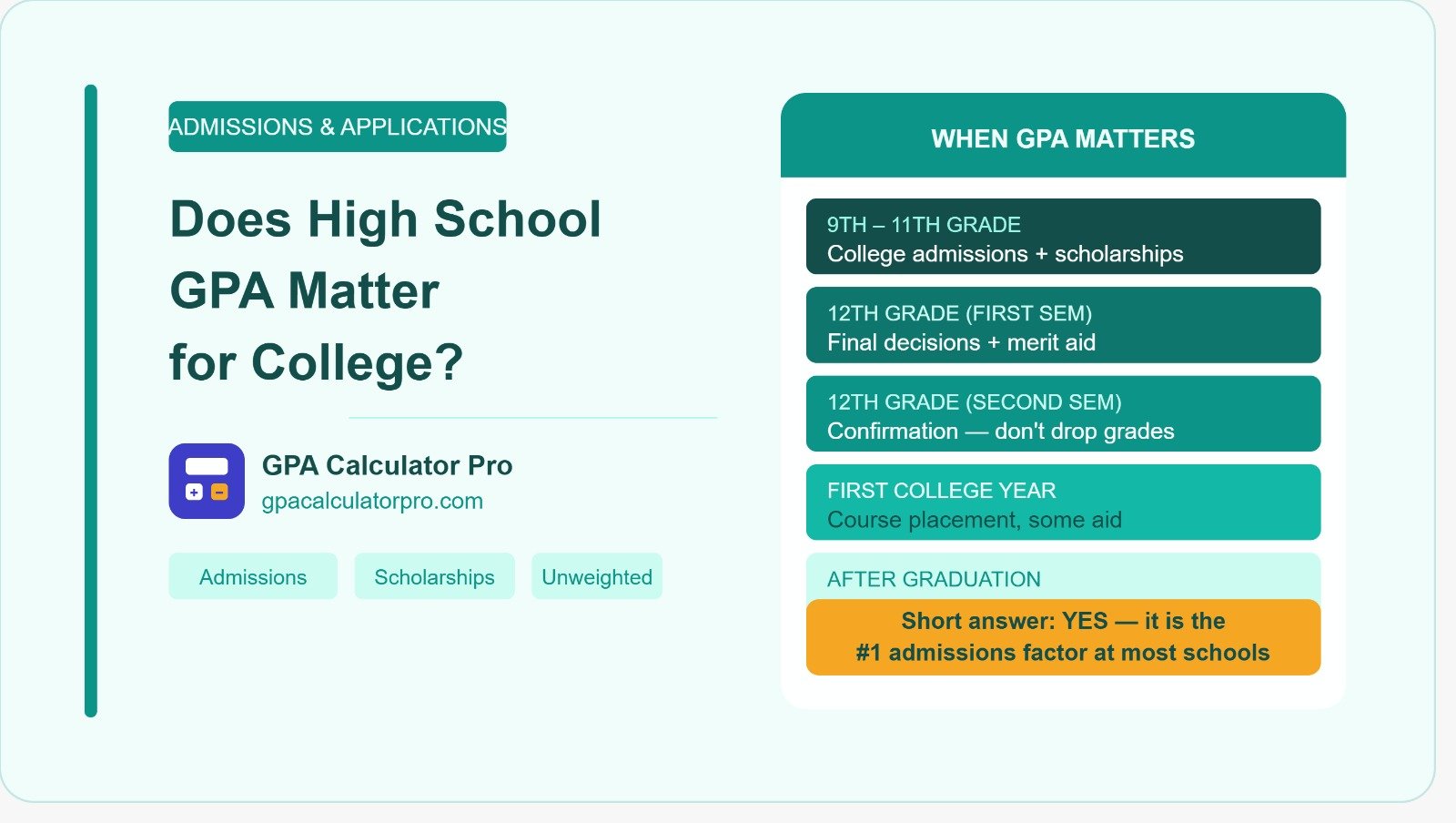
When Does High School GPA Matter Most?
| Timeframe | Matters for | How much |
|---|---|---|
| 9th – 11th grade | College admissions, scholarship eligibility | High - cumulative GPA builds across all four years |
| 12th grade (first semester) | Final admissions decisions, merit aid | High - many colleges request mid-year reports |
| 12th grade (second semester) | Admission confirmation only | Medium - colleges can rescind admission for dramatic grade drops |
| First college year | Course placement, some scholarship continuation | Low and fading |
| After graduation | Nothing | Zero - completely irrelevant |
What If Your High School GPA Is Lower Than You Need?
You are still in high school
If you are in 9th, 10th, or 11th grade, you still have meaningful time to move your cumulative GPA. The earlier you improve, the more semesters compound the benefit. Use our High School GPA Calculator to calculate your exact current GPA, then our GPA Planning Calculator to model what grades you need each remaining semester to reach your target before applications go out.
You are applying now with a lower GPA
- Apply across the right selectivity range: build a list with safety, match, and reach schools calibrated to where your GPA actually sits, not where you wish it did
- Highlight course rigor: a 3.2 in five AP courses reads better than a 3.2 in standard courses. Make sure your transcript tells that story clearly
- Show an upward trend: if your GPA improved significantly from freshman to junior year, address that trajectory in your application. Many admissions offices view a strong upward trend more favorably than a flat higher GPA
- Community college transfer pathway: if your high school GPA limits your 4-year options now, a strong 2-year community college record (3.0+) with the right courses can open transfer pathways to universities that your high school GPA would not have accessed
Frequently Asked Questions
Does high school GPA matter for college admissions?
Does high school GPA matter after college?
Does a low high school GPA ruin your chances?
Do colleges look at all four years of high school GPA?
Does class rank matter as much as GPA?
What GPA do I need to keep my scholarship in college?
Related Articles
Ready to know your exact GPA?
Calculate your weighted and unweighted GPA and see exactly where you stand.
Calculate My High School GPA