A low GPA on an application is not automatically disqualifying - but how you handle it matters significantly. Ignoring it when your number is clearly below a program’s typical range leaves the committee without context. Dwelling on it too much signals a lack of confidence. The approach that works is specific, brief, and forward-looking.
This guide covers when to address a low GPA, where in the application to do it, what to say, what not to say, and how to structure an explanation that strengthens rather than weakens your application.
First: Know Your Exact GPA Before You Write Anything
Before deciding how to address your GPA, confirm your exact number. Many applicants estimate or round - which creates risk if the committee requests a transcript and finds a discrepancy. Use our Cumulative GPA Calculator to calculate your precise figure, and run your major-specific courses separately to confirm your major GPA. In many cases, your major GPA is meaningfully higher than your overall - which changes how you frame your application entirely.
When Should You Explain a Low GPA?
Not every below-average GPA needs an explanation. The decision depends on how far your GPA falls from the program’s typical range and whether there is a genuine, verifiable reason for the gap.
| Situation | Explain? | Approach |
|---|---|---|
| GPA is within 0.2 of the program average | No | Let the rest of the application speak. A marginal difference does not need defence. |
| GPA is 0.3–0.5 below average with no special circumstance | Optional | Brief mention in additional info section only if you have a compelling narrative. Do not force it. |
| GPA has a clear upward trend (improved significantly by senior year) | Yes | Brief note in additional info section highlighting the trend. Let the transcript show it. |
| One or two difficult semesters pulled the average down | Yes | Briefly explain the circumstance, pivot to what you learned or did differently after. |
| First two years were weak, final two years were strong | Yes | Highlight your major GPA and upper-division performance. Frame the trajectory. |
| GPA is significantly below minimum (0.5+ below typical) | Yes | Required - but explanation alone is insufficient. Pair with strong test scores, post-bacc work, or exceptional experience. |
Where to Address a Low GPA in Your Application
Additional information section
Most applications - Common App, AMCAS, LSAC, and individual graduate school portals - include an optional "Additional Information" or "Is there anything else you want us to know?" section. This is the primary and preferred location for a GPA explanation. It is separate from your personal statement, which should remain focused on your narrative and goals rather than defensive explanations.
Personal statement or statement of purpose
Only address your GPA in the personal statement if it is directly tied to the story of why you are applying and what you have overcome. If you can write a compelling statement without mentioning your GPA, do that instead. Committees are sophisticated readers - a personal statement that leads with GPA defence often reads as a weaker application than one that leads with genuine purpose.
Addendum (law school applications)
Law school applications specifically use the term "addendum" for supplementary explanations. Most law schools accept and expect a GPA addendum if your number is below the school’s 25th percentile. Keep it to one page maximum - one paragraph is often sufficient.
Diversity statement or optional essays
If your low GPA is directly connected to a circumstance relevant to a diversity statement - socioeconomic hardship, first-generation status, disability, caregiving responsibilities - it may be appropriate to address it there. Do not force the connection, but do not avoid it if it is genuinely part of your story.
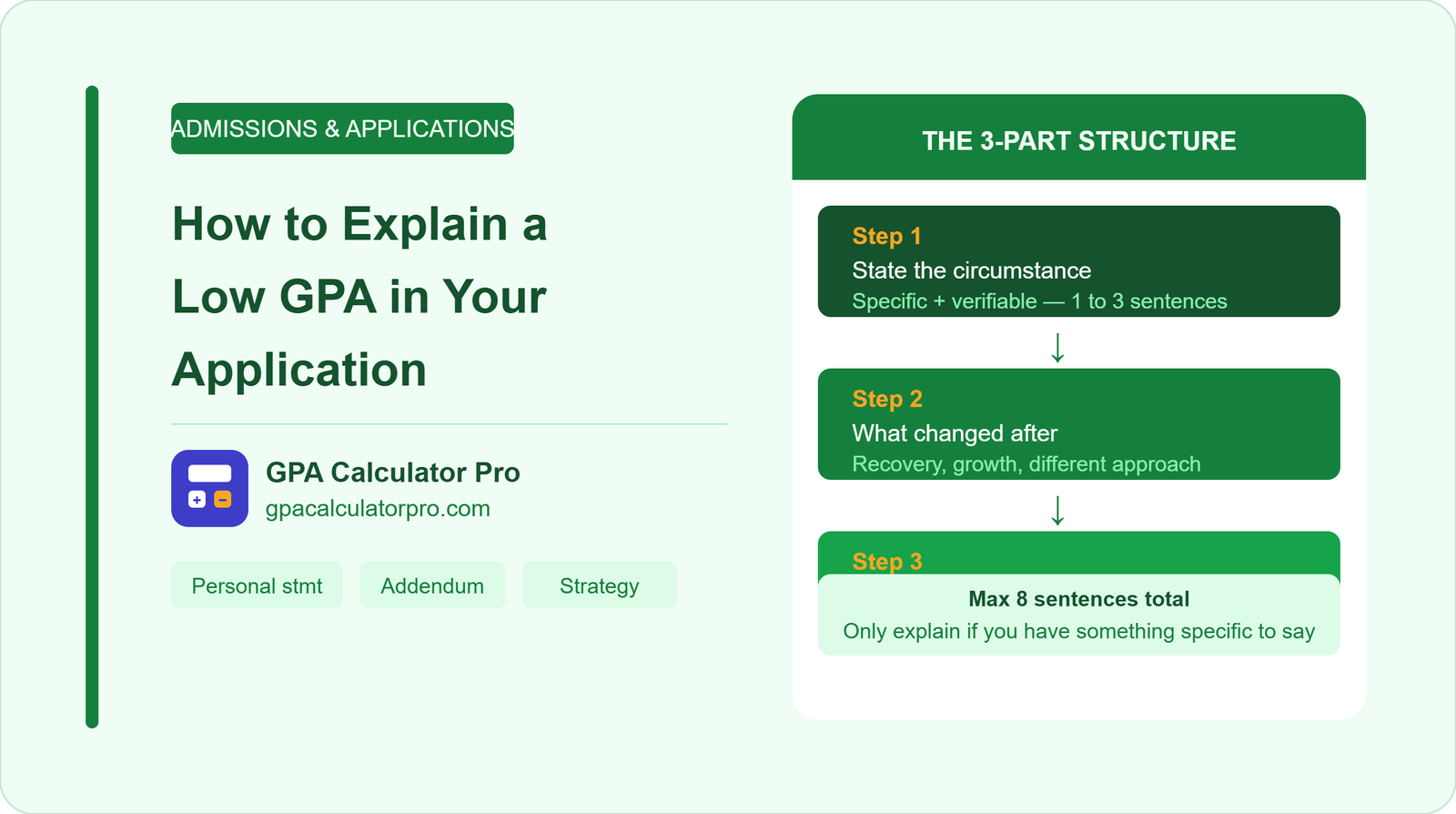
How to Write the Explanation - The 3-Part Structure That Works
The most effective explanations follow a simple, proven structure. Total length: three to eight sentences (one short paragraph in most cases; two paragraphs maximum for complex circumstances).
State the circumstance briefly and specifically
One to three sentences. Name the situation without excessive detail. Verifiable is better than vivid.
Note what changed or what you did
One to two sentences. What was different after the difficult period? Did your grades recover? Did you develop different study systems? Did you take on additional coursework?
Pivot to your current readiness
One sentence. Connect the explanation to your present capability, not your past difficulty.
Example - Medical circumstance
During my sophomore year, I was diagnosed with a chronic illness that significantly impacted my attendance and concentration for two semesters, resulting in my lowest GPA period (2.4 in fall 2022, 2.7 in spring 2023). Once I stabilized with treatment in junior year, my performance returned sharply - I earned a 3.6 and 3.8 GPA in my final two years and completed additional upper-division coursework in my major with a 3.9. I am sharing this context because my transcript does not reflect the trajectory, and I want the committee to have the complete picture.
Example - Financial/work circumstance
For three of my four undergraduate years, I worked 30–35 hours per week to cover tuition and living expenses without family financial support. This significantly limited the time I could dedicate to coursework and contributed to my overall GPA of 3.1. In my major courses, where I could apply focused effort, I maintained a 3.7. I am proud of what I achieved under those constraints and am entering this program in a financial position that will allow me to commit fully to the academic demands of the curriculum.
Example - Early college transition
My first two undergraduate years reflected a difficult transition to college academics - I was underprepared for the pace and self-direction required and my GPA suffered as a result (2.6 cumulative through sophomore year). In junior year, after changing my major to [field] and finding direction in coursework that genuinely engaged me, my performance changed substantially. My upper-division GPA in [field] is 3.8, and my final two years averaged 3.7. I believe this trajectory is a more accurate indicator of my graduate-level readiness than my cumulative figure.
What Not to Say
- Do not be vague. "I had some personal issues" tells the committee nothing and raises questions without answering them. Be specific or say nothing.
- Do not blame others. Blaming professors, grading systems, or course difficulty reads poorly. Focus on your circumstances and your response, not external fault.
- Do not apologize excessively. One brief acknowledgment is appropriate. Multiple apologies signal a lack of confidence in your application.
- Do not repeat it across multiple sections. Address the GPA once, in the appropriate section. Repeating it in the personal statement and the additional info section makes it seem like the dominant feature of your application.
- Do not exaggerate the circumstance. Applications are verified. If you claim a medical condition or family emergency, be prepared to provide documentation if requested by the program.
- Do not end on the GPA. Every explanation should pivot forward - to what you have done since, what you are capable of now, and what the committee should expect from you as a student in their program.
Compensating Factors That Strengthen Your Application
An explanation is more credible when paired with evidence of academic capability elsewhere in your application. The most effective compensating factors:
Strong GRE/GMAT/LSAT/MCAT score
Provides a standardized academic comparison point independent of GPA. Single strongest offset available for most programs.
High major GPA vs low overall GPA
Demonstrates competence in the field directly relevant to your application. List both: "GPA: 3.1 (cumulative), 3.8 (in major)"
Strong upward GPA trend
Shows growth and current capability even if early years were weak. Highlight senior year GPA specifically in the addendum.
Post-baccalaureate coursework with strong grades
Most recognized GPA-repair pathway for academic programs. 3.7+ in post-bacc work is a meaningful signal.
Relevant professional experience
Demonstrates capability in the field beyond academic credentials. Most effective for professional and applied programs.
Strong letters of recommendation
Particularly from professors who can speak to your academic ability directly. A recommendation that specifically addresses the GPA gap is powerful.
Does a Low GPA Affect All Programs Equally?
No - different program types weight GPA differently, and understanding this shapes your application strategy.
- Research PhD programs: research experience and fit with a specific advisor often matter more than GPA, particularly for STEM fields. A 3.2 GPA with two years of lab experience and a letter from a well-known researcher is a competitive application at many programs.
- Professional master’s programs: work experience and professional references carry more weight relative to GPA than academic master’s programs. A 2.9 GPA with five years of strong professional experience is viable at many applied master’s programs.
- MBA programs: GMAT/GRE score is the most direct offset to a low GPA, alongside professional achievement. A 2.8 GPA with a 720 GMAT and strong career progression is a competitive application at many MBA programs.
- Law school: GPA and LSAT together form the "index" that drives initial evaluation. A high LSAT score (170+) can compensate for a lower GPA at many programs, but the calculation is program-specific.
- Medical school: both overall GPA and science GPA are evaluated, and both matter significantly. Post-bacc work with strong science GPA is the most recognized compensation pathway for medical school applicants with low undergraduate GPAs.
If You Are Still in School - Act Now, Not Later
If you are still completing your degree, a GPA explanation is always second-best to an improved GPA. Every remaining semester is an opportunity. Use our College GPA Calculator to see your exact current position, then our GPA Planning Calculator to model what grades you need in remaining semesters to reach a more competitive number before you apply.
Frequently Asked Questions
How do I explain a low GPA in a personal statement?
Can a good personal statement overcome a low GPA?
Do I have to explain a low GPA?
How do I address a low GPA in a grad school application?
What if my low GPA has no specific reason?
Does a low undergraduate GPA affect graduate school applications forever?
Ready to strengthen your application?
Calculate your exact GPA and major GPA first - then build your explanation around real numbers.
Calculate My Cumulative GPA