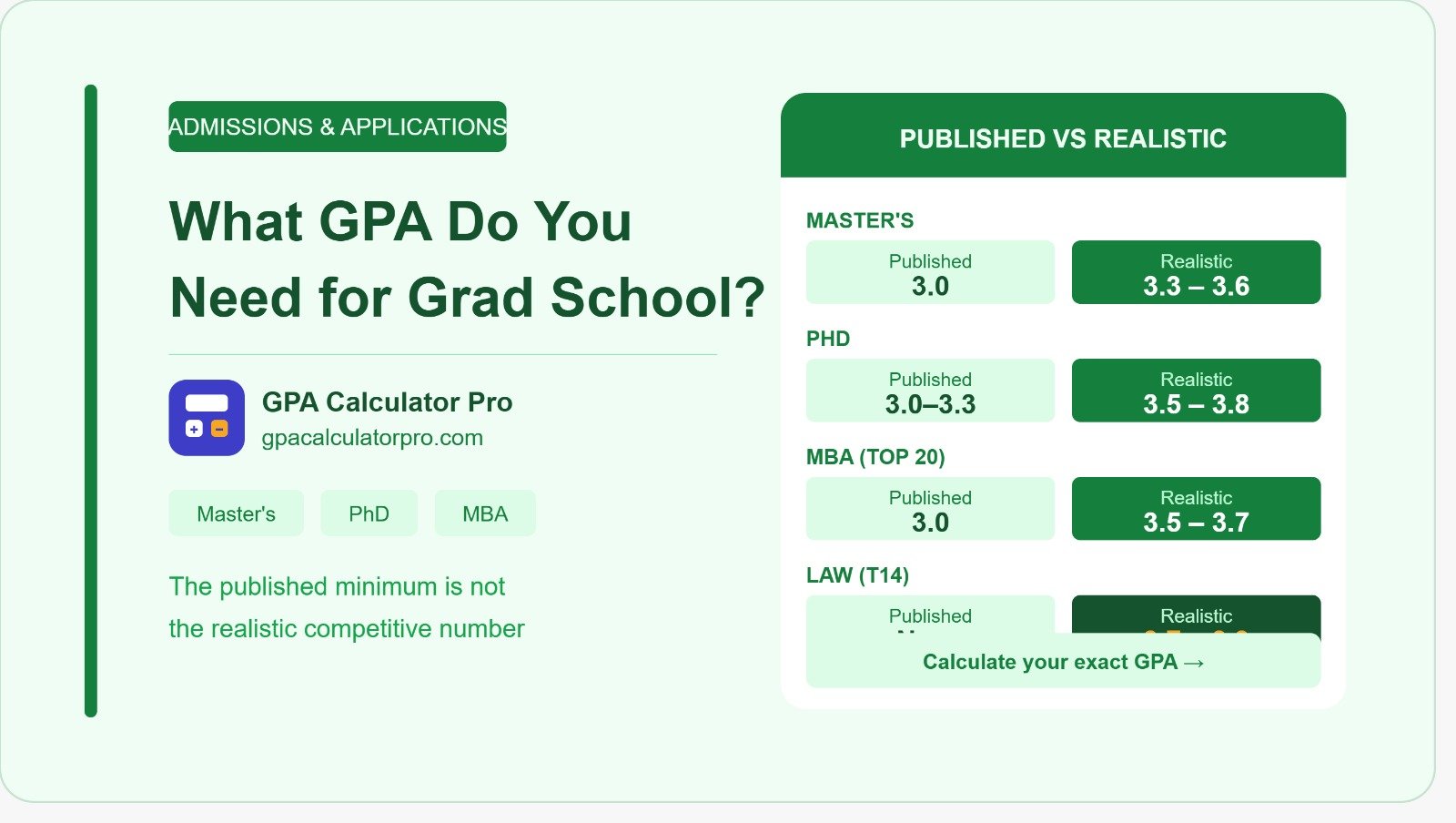
Every graduate program publishes a minimum GPA somewhere in its admissions requirements - usually 3.0. But that published minimum and your realistic chance of admission are two very different numbers. This guide breaks down what GPA actually gets you admitted, by program type, and what to do if your number falls short.
The Published Minimum vs. The Realistic Minimum
Most graduate programs state a 3.0 minimum GPA for admission consideration. This is the floor required for your application to be reviewed at all - not a realistic estimate of what gets you admitted. The actual competitive range at most programs sits meaningfully above the published minimum.
| Program Type | Published Minimum | Realistic Competitive Range |
|---|---|---|
| Master's (general) | 3.0 | 3.3 – 3.6 |
| PhD programs | 3.0 – 3.3 | 3.5 – 3.8 |
| MBA (top 20) | 3.0 | 3.5 – 3.7 |
| MBA (top 50) | 2.75 – 3.0 | 3.2 – 3.5 |
| Law school (T14) | None stated | 3.7 – 3.9 |
| Law school (T50) | None stated | 3.4 – 3.7 |
| Medical school | 3.0 | 3.6 – 3.9 (overall + science) |
What GPA Do You Need for a Master's Degree?
For most master's programs, a 3.0 GPA meets the minimum requirement, and 3.3–3.5 puts you in a genuinely competitive position. Calculate your exact cumulative GPA using our Cumulative GPA Calculator before evaluating which programs are realistic targets.
Factors that matter alongside GPA for master's admissions
- Major relevance: a GPA in coursework directly related to your target program (e.g. a 3.6 in Computer Science applying to a CS master's) carries more weight than the same GPA in an unrelated field
- Standardized test scores: GRE or GMAT scores can meaningfully offset a borderline GPA at many programs, though an increasing number of programs have gone test-optional
- Work experience: professional experience relevant to the field is weighted heavily for many part-time and executive-style master's programs, sometimes more than GPA
- Letters of recommendation: strong, specific recommendations from professors who can speak to your academic capability matter more at the margin than GPA differences of a few tenths
What GPA Do You Need for a PhD?
PhD admissions are more GPA-sensitive than most master's programs because doctoral study is fundamentally a research apprenticeship - committees want strong evidence of academic capability before investing years of funding and mentorship in a candidate. A 3.5+ is the realistic floor at most research universities; 3.7+ is competitive at top-ranked programs.
What matters most for PhD admissions, in rough order of importance:
- Research experience: undergraduate research, published work, or substantive lab experience often outweighs a GPA difference of several tenths
- Fit with a specific advisor: PhD admissions are frequently driven by whether a specific faculty member wants to take you on - this can matter more than your overall application profile
- GPA in your major/field: committees scrutinize your grades in upper-division coursework directly related to your intended research area more than your overall GPA
- Letters of recommendation: particularly from researchers who know your work directly, not just your coursework performance
- GPA trend: an upward trajectory - especially strong performance in your final two years - is read favorably even when the cumulative GPA is moderate
What GPA Do You Need for an MBA?
MBA admissions are unique among graduate programs because work experience and leadership trajectory often outweigh undergraduate GPA entirely - particularly for candidates with 5+ years of professional experience applying to executive or part-time programs. A strong GMAT/GRE score is the most direct lever available to offset a lower GPA at almost any MBA program.
| MBA Program Tier | Average Admitted GPA | Notes |
|---|---|---|
| Top 10 (Harvard, Stanford, Wharton) | 3.6 – 3.8 | GMAT/GRE and work experience carry equal or greater weight |
| Top 11–25 | 3.4 – 3.6 | Strong work experience can offset a lower GPA meaningfully |
| Top 26–50 | 3.2 – 3.5 | GPA matters less than at elite programs |
| Part-time / Executive MBA | 3.0 – 3.3 | Work experience and seniority are the primary admissions factors |
Can I Get Into Graduate School With a Low GPA?
Yes - a GPA below the competitive range does not automatically disqualify you, but it does require a deliberate strategy. Here are the most effective approaches, in order of impact:
Option 1: Strong Standardized Test Scores
A high GRE, GMAT, LSAT, or MCAT score is the single most direct way to demonstrate academic readiness despite a lower GPA. Admissions committees use test scores precisely because they provide a standardized comparison point that GPA, with its wide variation across institutions and grading practices, cannot offer alone.
Option 2: Post-Baccalaureate Coursework
Taking additional upper-division coursework after graduation - either through a formal post-bacc program or as a non-degree student - and earning strong grades (3.7+) directly demonstrates that your undergraduate GPA does not reflect your current academic capability. This is the most recognized GPA-repair pathway for graduate, medical, and law school applicants alike.
Option 3: A Compelling Explanation, Briefly Stated
If your low GPA resulted from a specific circumstance - illness, family emergency, financial hardship, a difficult transition - most applications include space for an addendum or note. State it briefly and factually without dwelling on it, then pivot immediately to what you have done since to demonstrate readiness.
Option 4: Relevant Work or Research Experience
Demonstrated capability in the field - through employment, research assistance, volunteer work, or independent projects - gives admissions committees evidence beyond your transcript. This is particularly effective for professional and applied master's programs.
Option 5: A Strong Upward GPA Trend
If your GPA improved substantially from freshman to senior year, that trajectory is a meaningful part of your story. A student who went from a 2.6 freshman GPA to a 3.6 senior GPA (resulting in a 3.2 cumulative) demonstrates something different than a flat 3.2 - and most applications give you space to address this directly in your statement of purpose.
Does Major GPA Matter More Than Overall GPA for Graduate School?
For most graduate programs, yes - your GPA within your major or in courses directly relevant to your target program carries more weight than your overall cumulative GPA. A 3.2 overall with a 3.8 in your major is a stronger signal for a directly related graduate program than the reverse.
Calculate both figures precisely before evaluating your competitiveness. Use our College GPA Calculator for your overall GPA, then run your major-specific courses separately to get an accurate major GPA. Many applicants discover their major GPA is meaningfully higher than they assumed - which materially changes how they should present their application.
How to Improve Your GPA Before Applying
If you are still completing your undergraduate degree and graduate school is on the horizon, every remaining semester is an opportunity to move your GPA toward the competitive range.
- Calculate your exact current GPA. Use the Cumulative GPA Calculator to know precisely where you stand - not an estimate.
- Model your realistic ceiling. Use our GPA Planning Calculator to see exactly what GPA is achievable given your remaining credits, and what grades each semester requires to get there.
- Prioritize your major coursework. Since major GPA often matters more than overall GPA for graduate admissions, concentrated effort in your field-relevant courses delivers more application value than spreading effort evenly.
- Know your final exam targets every semester. Before each finals period, calculate the exact score needed in each course to hit your target grade - this is the most tactical lever available in your remaining semesters.