One week before finals is not ideal - but it is far from hopeless. Most students who enter finals week with one week of preparation time and no plan end up either over-studying subjects they have already secured or under-preparing for the exams that actually matter. The difference between passing and failing in this window is almost always about prioritisation, not total hours.
This guide gives you a realistic day-by-day plan built around your actual situation, not a generic “study hard” template that ignores what you actually need on each exam.
Before Day 1 - The Only Preparation That Actually Matters
Before you open a single textbook, do this one thing: calculate your required final exam score for every course. Use the Final Grade Calculator - enter your current grade, your target grade, and the weight of the final. Do this for every course. This takes 10 minutes and is more valuable than anything else you can do right now.
Here is why it changes everything:
| Required Score | What This Means for Your Week |
|---|---|
| 0% or negative | Grade already locked. Skip this course entirely - studying it is wasted time |
| Under 60% | Very comfortable. One focused review session is enough |
| 60% – 74% | Manageable. Two sessions - one content review, one practice |
| 75% – 89% | This exam matters. Three to four sessions minimum |
| 90% – 100% | High stakes. Maximum preparation, this is your priority |
| Above 100% | Lower your target. Recalculate with realistic grade, then assign time |
The prioritisation rule
With one week, you cannot prepare deeply for everything. Students who try to study everything equally run out of time before covering what actually matters. Let the required score numbers tell you where to spend your hours - high required score = more sessions, low required score = fewer sessions, already secured = zero sessions.
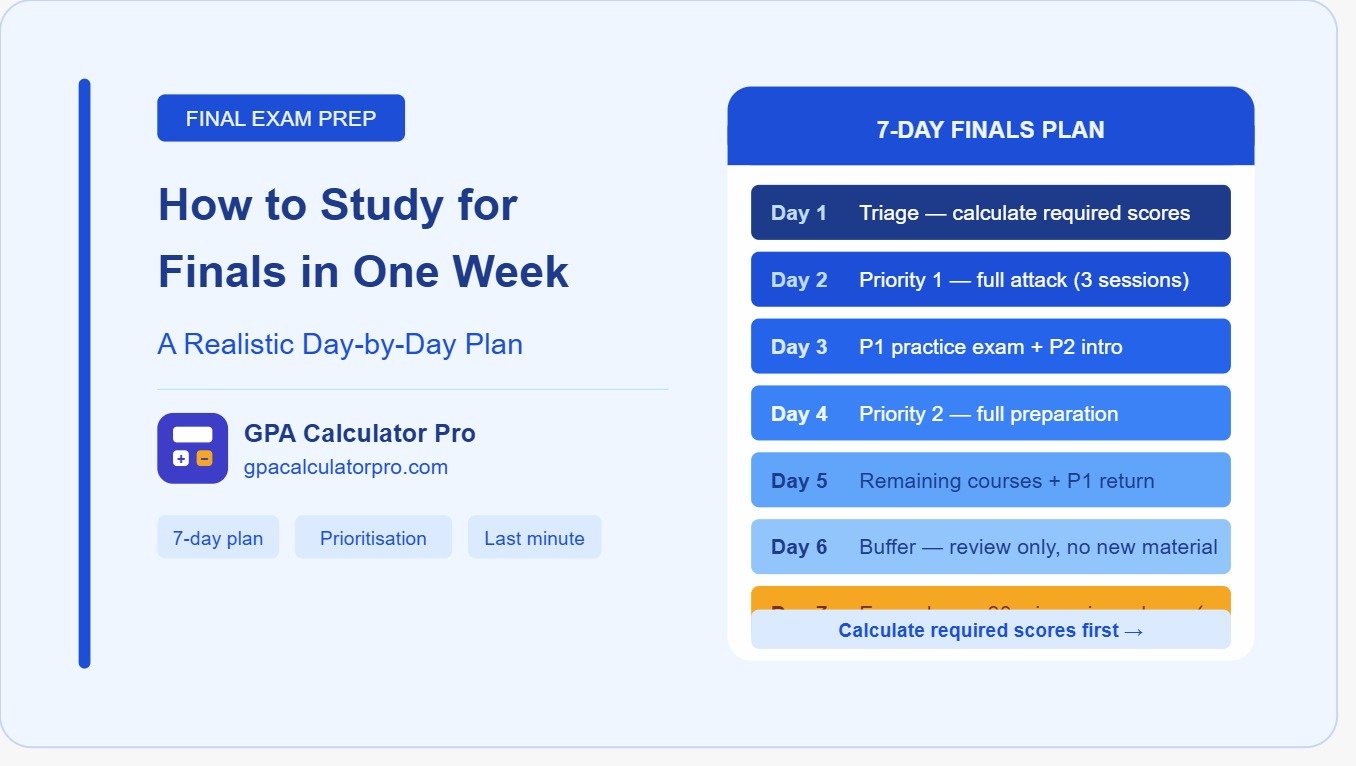
The 7-Day Finals Study Plan
Day 1 - Triage and Set Up
This day is not for studying content. It is for building the foundation that makes the next six days productive.
- Run the Final Grade Calculator for every course. Write down your required score for each exam.
- Rank your courses by required score. Highest required score = Priority 1. Already secured = cut from your schedule entirely.
- List your exam dates in order. Map which courses need preparation before which deadlines.
- Assign study sessions to each course. Proportional to required score. Three to four sessions for high-stakes exams, one to two for comfortable ones.
- Gather all materials for Priority 1 course. Notes, practice exams, formula sheets, syllabus. Have everything ready so Day 2 starts immediately.
Day 2 - Priority 1 Course, Full Attack
Your highest-stakes exam gets all of Day 2. This is the course where you need the highest score - it deserves your freshest cognitive energy.
- Morning session (90 min): Full content review. Work through your notes or summary sheet for the entire course. Flag topics you do not remember clearly.
- Afternoon session (90 min): Targeted review of flagged topics only. Do not re-read everything - only the gaps you identified in the morning.
- Evening session (90 min): Active recall. Close your notes and test yourself. Use flashcards, blank-page recall, or past exam questions. Do not open notes unless completely stuck.
Three sessions. Ninety minutes each. Specific breaks between them. This is the maximum productive output for one day on one subject.
Day 3 - Priority 1 Continued + Priority 2 Introduction
Split today between your two highest-priority courses.
- Morning session (90 min): Priority 1 - complete at least one full past exam or practice test under timed conditions. Grade it immediately. Note every question you got wrong.
- Afternoon session (90 min): Priority 1 - review every question you got wrong on the practice exam. Understand why, not just what the right answer was.
- Evening session (90 min): Priority 2 - introductory content review. Work through your notes for this course, flag gaps, identify the highest-weight topics from the syllabus or past exams.
By end of Day 3, your Priority 1 exam preparation is substantially complete. You have a practice exam result to guide final targeted review.
Day 4 - Priority 2 Full Preparation
- Morning session (90 min): Priority 2 - targeted content review on high-weight topics identified on Day 3.
- Afternoon session (90 min): Priority 2 - active recall and practice problems. Past exam if available.
- Evening session (90 min): Priority 3 course - first review session. Even a comfortable exam deserves one preparation session.
Day 5 - Remaining Courses + Final Review on Priority 1
- Morning session (90 min): Priority 3 course - complete preparation. If required score is under 65%, one solid session is sufficient.
- Afternoon session (90 min): Any remaining courses with required scores above 70% - one session each.
- Evening session (60 min): Return to Priority 1 for a final targeted review. Focus only on the specific topics you got wrong on the Day 3 practice exam. Nothing new.
Day 6 - Buffer and Consolidation
Day 6 is the most important day most students waste. This is your buffer day - the day that separates students who walk in confident from students who walk in anxious.
- No new material: You do not have time to learn new concepts and consolidate them before the exam. New material learned on Day 6 is more likely to create confusion than clarity.
- Review only: Work through your one-page summary or key formula sheet for Priority 1. Light review of Priority 2. Nothing for already-secured courses.
- Confirm logistics: Exam time, location, what you are allowed to bring, calculator policy, ID. Prepare everything the night before so the morning of is zero friction.
- Sleep by a reasonable hour: This is not optional. Memory consolidation happens during sleep. The material from Days 2–5 is being processed tonight. Protect it.
Day 7 - Exam Day
- Morning of exam: 30 minutes of light review maximum. Key formulas, dates, or concepts you flagged as weak. No deep studying.
- Eat something real: Cognitive performance drops measurably without adequate nutrition. This is not incidental advice.
- Arrive early: Last-minute rushing creates anxiety that directly impairs retrieval. Being seated and settled five minutes before the exam starts matters.
- After the exam: Do not immediately debrief with classmates about questions you may have answered differently. It serves no purpose and increases anxiety for subsequent exams. Move on.
What to Do If You Have Multiple Exams on the Same Day
Back-to-back exams on the same day require prioritisation within the day. Prepare for them in reverse chronological order on the day before - study for the later exam first, then the earlier exam last. Your final review before sleep should be for whichever exam is first.
The day of:
- Between exams, do not attempt to study new material for the second exam.
- Light review only - one page of key notes maximum between exams.
- Eat and hydrate between exams - cognitive fatigue is a real performance factor across back-to-back tests.
Last-Minute Finals Studying - What Works and What Does Not
What works in one week
- Past exams: The highest-return study resource available. If your professor has released any, these are your primary preparation material - not the textbook, not your notes.
- Active recall: Testing yourself on material consistently outperforms re-reading at every time horizon, but especially when time is short.
- Focused topic targeting: Study the highest-weight topics confirmed by the syllabus, past exams, or professor study guides - not everything equally.
- Sleep protection: Non-negotiable even in cramming mode. Six to seven hours minimum. The cost of lost sleep on exam performance exceeds the benefit of additional late-night study time.
What does not work in one week
- Re-reading textbooks: Time-intensive, low retention, overwhelms rather than consolidates.
- Highlighting and colour-coding notes: Feels productive, retains almost nothing without active recall follow-up.
- Studying everything equally: Wastes time on secured courses and under-prepares high-stakes ones.
- All-nighters: Consistently produce worse exam outcomes than sleeping. An all-nighter before an exam is almost always the wrong trade.
- Group study for initial learning: Group study works for testing each other on content you already know. It does not work efficiently for first-pass learning of new material when time is short.
How to Handle Specific Difficult Situations
You have an exam tomorrow and have not started
This is the most extreme version of last-minute prep. Use the Final Grade Calculator immediately - find your required score. If the required score is under 70%, one focused night of past exam practice and active recall on high-weight topics can get you there. If it is above 90%, lower your target grade to a realistic ceiling and study to that. Do not study without knowing your target score.
You have five exams in three days
Triage ruthlessly. Calculate required scores for all five. Drop already-secured courses from your schedule entirely. If two exams are within 12 hours of each other and one has a low required score, give that one minimal time and redirect it to the high-stakes exam. One focused session on a low-stakes exam the morning before is better than splitting time equally between a 40%-required exam and a 91%-required exam.
You understand the material but panic during exams
Performance anxiety during exams is often caused by uncertainty about what the exam will contain and whether preparation was adequate. Past exam practice under timed conditions - sitting at a desk, timing yourself, no notes - directly reduces this by making the exam format feel familiar. Do at least one timed practice exam for every high-stakes course during the week.
After Finals - Check the Numbers
When grades post, immediately calculate where your semester GPA and cumulative GPA have landed. Use our Semester GPA Calculator for this semester’s result, then our Cumulative GPA Calculator to see your updated overall standing.
If this semester did not go as planned, model what next semester needs to look like. Our GPA Planning Calculator shows exactly what grades you need each semester to reach your target GPA before graduation. One difficult semester does not define your academic record - but knowing your numbers immediately after lets you plan your recovery before the next term starts.