You ran the numbers. You entered your current grade, your target grade, and how much your final is worth - and the calculator came back with 108%. Or 115%. Or 134%.
That number is not a bug. It is the math telling you something important. Here is exactly what it means, what your options actually are, and what to do right now.
What Does It Mean When You Need Above 100% on Your Final?
A required final score above 100% means the grade you are targeting is mathematically impossible to achieve through your final exam alone. No matter how perfectly you perform on the final, the combination of your current grade and the exam’s weight cannot produce that target grade.
The calculator is giving you an honest answer based on the mathematical formula:
$$Required\ Score = \frac{Target\ Grade - Current\ Grade \times (1 - Final\ Weight)}{Final\ Weight}$$
When this result exceeds 100, it means the gap between where you are and where you want to be is larger than what the final exam can bridge. The final exam simply does not carry enough weight to make up the difference.
A result above 100% is not a failing grade. It means one specific letter grade is out of reach. Your current grade is still your floor - you will finish the course with at least your current standing minus any impact from a low final exam score. The question is what grade is still realistically achievable.
Why This Happens - The Math Explained
Three factors determine whether a grade is still reachable:
- Your current grade: The lower your current grade, the bigger the gap to close.
- Your target grade: The higher the target, the more points needed.
- The final exam weight: The lower the weight, the less the final can move your overall grade.
The combination that most commonly produces an above-100% result: a low current grade, a high target grade, and a final that only counts for 20–30% of the course. Here is an example:
| Input | Value |
|---|---|
| Current grade | 62% |
| Target grade (A) | 90% |
| Final exam weight | 25% |
| Required score calculation | (90 − 62 × 0.75) ÷ 0.25 = (90 − 46.5) ÷ 0.25 = 174% |
| Result | 174% - impossible |
A 174% requirement means the A was never mathematically possible from this position. But that does not mean the course is lost. It means the A is lost - not the course.
Step 1 - Find the Highest Grade Still Achievable
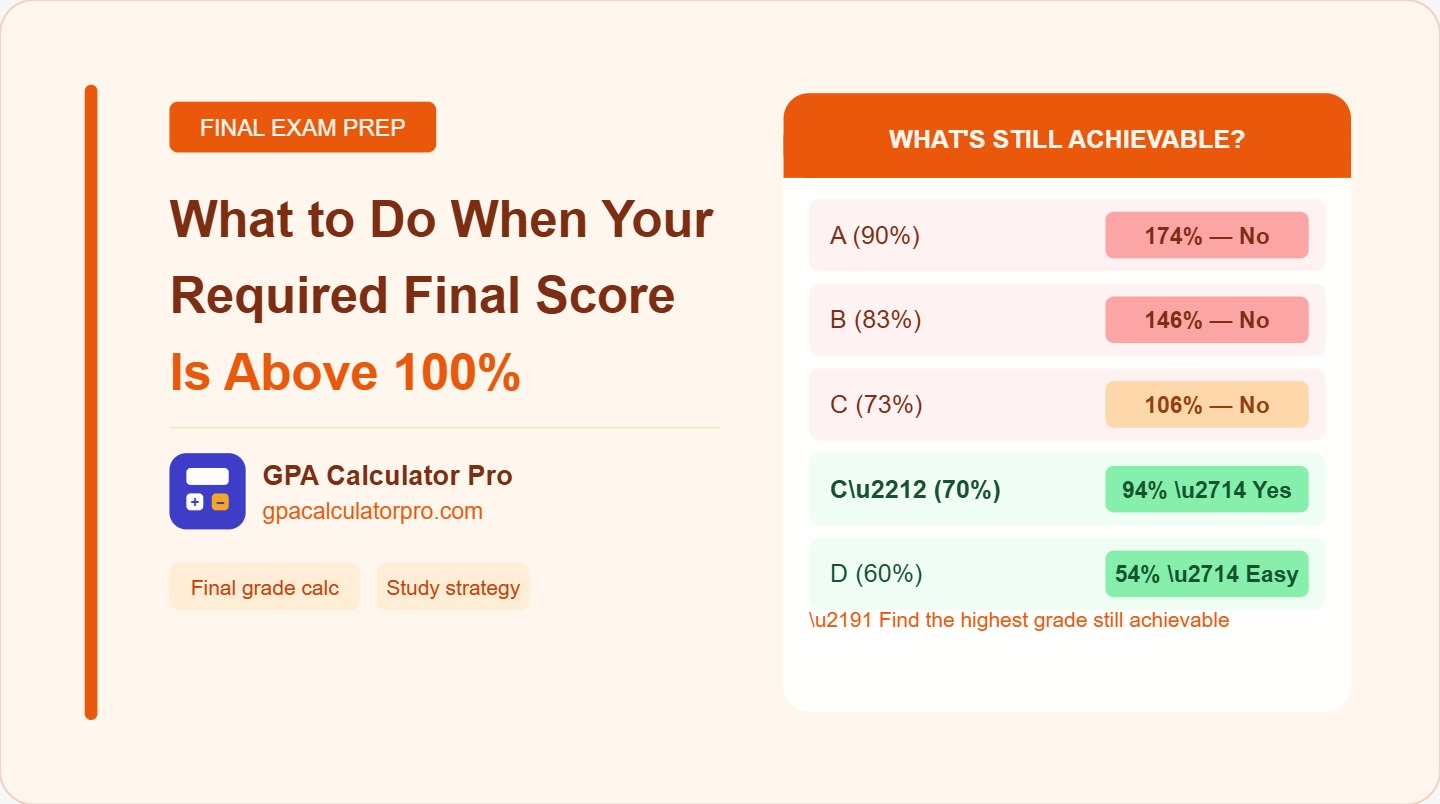
The most important thing to do immediately: recalculate with a lower target grade. Open the Final Grade Calculator and work down through the letter grades until you find the highest one that returns a score at or below 100%.
| Target grade | Required score (62% current, 25% weight) | Achievable? |
|---|---|---|
| A (90%) | 174% | No |
| B+ (87%) | 162% | No |
| B (83%) | 146% | No |
| B− (80%) | 134% | No |
| C+ (77%) | 122% | No |
| C (73%) | 106% | No - just out of reach |
| C− (70%) | 94% | Yes - achievable with strong effort |
| D (60%) | 54% | Yes - comfortable |
In this example, a C− (70%) is the highest grade still achievable. A 94% on the final is very challenging but possible. A C (73%) requires 106% - not achievable. So the realistic target is C−, aiming for the best final exam performance possible to get as close to C as the math allows.
Run this same exercise for every course where you are stuck. It takes two minutes per course using the Final Grade Calculator and tells you exactly which courses deserve your hardest push and which are already settled.
Step 2 - Understand What a Lower Grade Does to Your GPA
Once you know your realistic ceiling for each course, calculate what finishing at that grade does to your semester GPA and cumulative GPA. This is important because it determines what you need from other courses to protect your overall standing.
Enter your projected final grades - including the adjusted target for the difficult course - into our Semester GPA Calculator to see where your GPA lands. Then decide whether to push harder in your other courses to offset the impact.
The Offset Strategy
If one course is settled at a C−, you may be able to offset its GPA impact by pushing for A’s in your other courses. A C− in a 3-credit course pulls your semester GPA down by roughly 0.3–0.4 points depending on your other grades. An A in another 3-credit course pushes it up by approximately 0.3–0.4 points. The offset is often achievable if you redistribute study time early enough. You can map this long-term impact out using our GPA Planning Calculator.
Step 3 - Decide Whether to Talk to Your Professor
In some situations, speaking to your professor directly is the right move. Here is when it is worth doing and when it is not:
When to talk to your professor:
- You are on the borderline of a passing grade and the result matters for GPA minimums, scholarships, or academic standing.
- Your course has extra credit opportunities that are not reflected in the calculator.
- You believe your current recorded grade contains an error - missing assignment, incorrect entry.
- You are in a program with a minimum grade requirement (nursing, education, engineering) and failing to meet it has serious consequences.
- The grade you are targeting is needed for graduation or to avoid academic probation.
When not to bother:
- You simply want a higher grade than the math allows and there is no error or special circumstance.
- The course does not have extra credit and your professor has not offered any flexibility.
- The grade in question is not a graduation or standing requirement.
Step 4 - Maximise Your Actual Final Exam Score
Once you know your realistic target grade, focus your preparation on achieving the best possible score on the final - not on a grade you cannot reach. This is the most productive use of your remaining time.
- Study to your realistic target, not beyond it: If you need 94% on the final for a C−, study as if your target is 97–98% to build in a buffer. Do not aim for 75% because the A is impossible - every point on the final still moves your grade within the range that is achievable.
- Prioritise the highest-weight topics: Get your professor’s study guide, past exams, or learning objectives. Roughly 20% of the content generates 80% of the exam questions. Focus there first.
- Use active recall, not passive review: Re-reading notes feels productive but retains little. Test yourself on material without looking - this is the fastest retention method available.
- Protect your other courses: Do not sacrifice a course where you can still achieve your target grade in order to study more for a course where the outcome is already largely determined.
Common Scenarios - What Above 100% Looks Like in Practice
My final is worth 50% and I still need 110%
A 50%-weight final is a significant lever - it means the final can move your grade dramatically in either direction. Needing 110% on a 50%-weight final means your current grade is very low (typically below 50–55%). In this case, passing the course itself may be at risk. Calculate the minimum required score for a D or passing grade - if even that requires above 100%, contact your professor about withdrawal options or incomplete policies immediately.
My final is worth 20% and I need 140%
A low-weight final with a high required score means the gap was created long before finals week - through missed assignments, low test scores, or poor quiz performance. The final cannot fix a hole this large. Accept the realistic grade ceiling, protect your other courses, and plan how to address this in your GPA recovery if needed.
I only need 101% - is there any way?
If you need 101–103% and your professor offers any extra credit - even a small amount - it may bring your effective target below 100%. One point of extra credit on a 20%-weight final is worth 5 percentage points on the final requirement. Ask your professor specifically about extra credit options before concluding the grade is impossible.
I need above 100% just to pass
This is the most urgent scenario. If even a passing grade (60%) requires above 100% on your final, you cannot pass through the final alone. Your options: (1) check whether extra credit is available, (2) speak to your professor about an incomplete grade if extenuating circumstances apply, (3) consider whether late withdrawal is still possible - a W on your transcript is better than an F for most GPA situations, (4) contact your academic advisor immediately.
What This Means for Your GPA Going Forward
One course finishing below your target grade affects your semester GPA but rarely defines your academic trajectory. Use our Final Grade Calculator to confirm your final course grade based on your realistic exam performance, then model your cumulative GPA impact and recovery path.
The practical steps after this semester:
- Grade replacement: If grade replacement is available at your school, retaking a course where you earned a D or F and replacing the grade removes the quality points drag from your cumulative GPA.
- Target setting: If you need a specific GPA for a scholarship, program, or academic standing, calculate exactly what you need from next semester using the GPA Planning Calculator.
- Address root causes: If this is a pattern across multiple courses, address the root cause - whether it is time management, course load, or specific subject gaps - before the next semester begins.