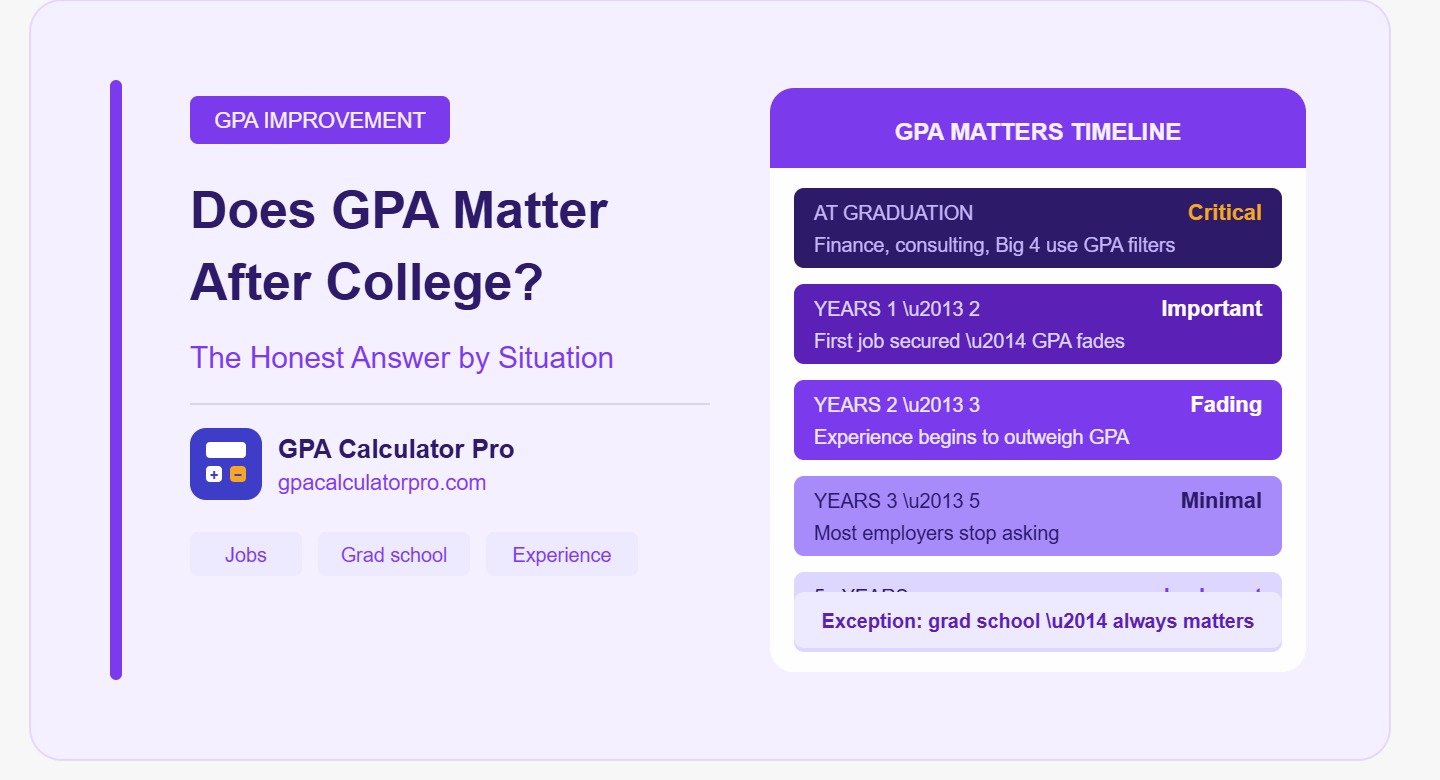
The honest answer to whether GPA matters after college is: it depends entirely on what you are doing next and how long ago you graduated. For some paths, GPA remains decisive for years. For others, it becomes irrelevant the moment you accept your first job offer. Most people fall somewhere in between.
This guide breaks it down by situation so you know exactly when your GPA matters, when it does not, and what to do if yours is not where you want it to be.
The Short Answer - When GPA Matters and When It Does Not
| Situation | Does GPA matter? | How long? |
|---|---|---|
| First job search after graduation | Yes - significantly for competitive employers | Until you have 2–3 years of work experience |
| Graduate school applications | Yes - always, for every program | Permanently - your undergrad GPA is always on record |
| Medical / law / dental school | Yes - critically | Permanently |
| MBA programs (top) | Yes - for top programs | Permanently, offset by strong GMAT and work experience |
| Government / federal jobs | Sometimes - depends on the agency and role | Recent graduates only in most cases |
| Finance, consulting, Big 4 | Yes - GPA cutoffs are standard | Until 2–3 years of experience |
| Tech companies (most) | Rarely after first job | Almost never after first role |
| Entrepreneurship / startups | No | Never |
| Professional certifications | No | Never |
| Job searches 5+ years post-graduation | Almost never | Irrelevant in most industries |
Does GPA Matter for Jobs?
For your first job search after graduation: yes, GPA matters - more than most students expect. Many large companies use automated application systems that screen out resumes below a stated GPA threshold before a human ever reviews them. The most common cutoffs are 3.0 as a minimum and 3.5 for competitive programs.
The industries where GPA screening is most aggressive at the entry level:
- Investment banking and finance: bulge-bracket banks and asset managers routinely use 3.5+ cutoffs. Some explicitly state 3.7 for their most selective analyst programs
- Management consulting: McKinsey, BCG, Bain and similar firms use GPA as a first filter. 3.5 is typically the floor; competitive candidates average 3.7+
- Big 4 accounting: GPA thresholds of 3.0–3.3 are common in early screening
- Government and federal agencies: some agencies (FBI, CIA, Department of State) request transcripts. Many federal honours programs require 3.5 minimum
- Large corporates with structured rotational programs: these programs recruit from campus and use GPA to filter the applicant pool
Does GPA Matter for Graduate School?
Yes - your undergraduate GPA matters permanently for graduate school applications, regardless of how long ago you graduated. There is no expiry date on your transcript. If you apply to a master’s program ten years after graduating, admissions committees will still review your undergraduate GPA alongside any post-graduate experience.
Requirements by program: What GPA Do You Need for Graduate School?
GPA thresholds by program type
| Program | Typical minimum GPA | Competitive GPA | Notes |
|---|---|---|---|
| Most master’s programs | 3.0 | 3.3–3.5 | Work experience can partially offset lower GPA |
| PhD programs | 3.3 | 3.5–3.8 | Research experience often outweighs GPA |
| Top MBA programs | 3.0 stated; 3.3 practical | 3.5–3.7 | GMAT/GRE and work experience carry heavy weight |
| Law school (T14) | 3.5 | 3.7–3.9 | LSAT is equally or more important |
| Medical school | 3.5 overall + 3.5 science | 3.7+ both | Science GPA evaluated separately |
| Dental / pharmacy | 3.0–3.2 | 3.4–3.6 | DAT/PCAT scores complement GPA |
If your GPA is below the competitive range for your target program, calculate your exact current figure using our College GPA Calculator and then model what remaining coursework could do with our GPA Planning Calculator. A post-bacc program or additional coursework with strong grades is often the most effective way to demonstrate academic readiness.
Does Major GPA Matter More Than Overall GPA?
For graduate school and technical roles: yes, major GPA often matters more than overall GPA. A student with a 3.2 overall but a 3.8 in their major is demonstrating exactly the subject-matter competence that both graduate programs and employers in that field care about most.
How to use this strategically:
- On your resume: list both GPAs if your major GPA is 0.3 or more above your overall GPA. Format it as: “GPA: 3.2 (cumulative), 3.8 (in major)”
- On applications: most forms ask for cumulative GPA. Major GPA is supplementary - include it in your personal statement or interview where relevant
- For technical employers: a strong major GPA in Computer Science, Engineering, or Finance often carries more weight than the cumulative GPA when the role is directly field-specific
Do Employers Check GPA?
Whether employers actually verify GPA depends on the employer and the role:
- Large companies with structured recruiting: yes - many use automated ATS systems that filter by GPA before a human sees your application
- Campus recruitment: yes. Campus recruiters routinely ask about GPA before deciding whether to invite students to formal interviews
- Background checks: some employers (finance, law, government) request official transcripts as part of pre-employment screening
- Most small and mid-size companies: rarely verify GPA formally
- After 3–5 years of experience: almost no employer requests or verifies academic transcripts
What If Your GPA Is Lower Than You Want?
You are still in college
If you are still completing your degree, your GPA is not fixed. Every semester still matters. Use our Cumulative GPA Calculator to see exactly where you stand, and our GPA Planning Calculator to model what grades you need in remaining semesters to reach your target.
You recently graduated with a low GPA
Your options depend on what you want to do next:
- For employment: prioritise gaining relevant experience quickly. An internship, entry-level role, or strong portfolio project shifts the conversation from academic performance to professional capability within 12–18 months
- For graduate school: a post-baccalaureate program with strong grades (3.7+) is the most recognised GPA repair pathway
- Be transparent if asked: if an interviewer asks about your GPA, have a brief, honest explanation ready: “I had a difficult first two years, but my final year GPA was 3.6 and I have demonstrated my capabilities through X and Y”
You graduated years ago
If you are more than 3 years out of college, your GPA is largely irrelevant for most job searches. Stop including it on your resume unless a job application specifically requests it. After 5+ years, the conversation is entirely about what you have done professionally.
Industries Where GPA Never Really Mattered
Some career paths have never placed significant emphasis on GPA, even at the entry level:
- Entrepreneurship: no investor or customer has ever asked a founder for their transcript
- Creative fields (design, media, advertising): portfolio quality and demonstrated skills consistently outweigh academic credentials
- Trades and technical certifications: professional certifications and demonstrated competency are the only credentials that matter
- Sales: performance metrics and demonstrated ability to close deals replace academic signals almost immediately
- Most startup roles: startups typically care about what you can do right now, not what you earned academically years ago