Weighted GPA is one of the most misunderstood numbers in high school academics. Students know they have one, colleges ask about it, and counselors calculate it - but most students cannot explain what the weighting actually does to their GPA or how to verify their own number.
This guide breaks down exactly how weighted GPA is calculated, what the difference between weighted and unweighted means for college applications, and how to calculate your own weighted GPA by hand or with a calculator.
What Is Weighted GPA?
Weighted GPA is a grade point average that assigns bonus points to grades earned in advanced courses - AP, IB, and Honors classes - to reflect the extra difficulty of those courses. On a standard unweighted 4.0 scale, an A is always worth 4.0 regardless of whether it was earned in a regular English class or AP Physics. On a weighted scale, that same A in AP Physics is worth 5.0.
The logic behind weighting: a student who earns a B in AP Calculus is demonstrating a different level of academic capability than a student who earns a B in regular Algebra. Weighted GPA attempts to capture that difference in a single number.
Weighted vs Unweighted GPA - Key Differences
| Metric | Unweighted GPA | Weighted GPA |
|---|---|---|
| Scale | 0.0 – 4.0 | 0.0 – 5.0 (or higher) |
| A in regular class | 4.0 | 4.0 |
| A in Honors class | 4.0 | 4.5 |
| A in AP / IB class | 4.0 | 5.0 |
| B in regular class | 3.0 | 3.0 |
| B in Honors class | 3.0 | 3.5 |
| B in AP / IB class | 3.0 | 4.0 |
| Max possible GPA | 4.0 | 5.0+ |
| Used by colleges for comparison | Primary | Secondary context |
Colleges use your unweighted GPA as the primary comparison metric because it is standardized across all schools. Weighted GPA is secondary context - it tells admissions officers you challenged yourself, but the unweighted number is what goes into their data systems. Know both, but prioritize your unweighted GPA when evaluating your college competitiveness.
The Weighted GPA Scale - How Bonus Points Work
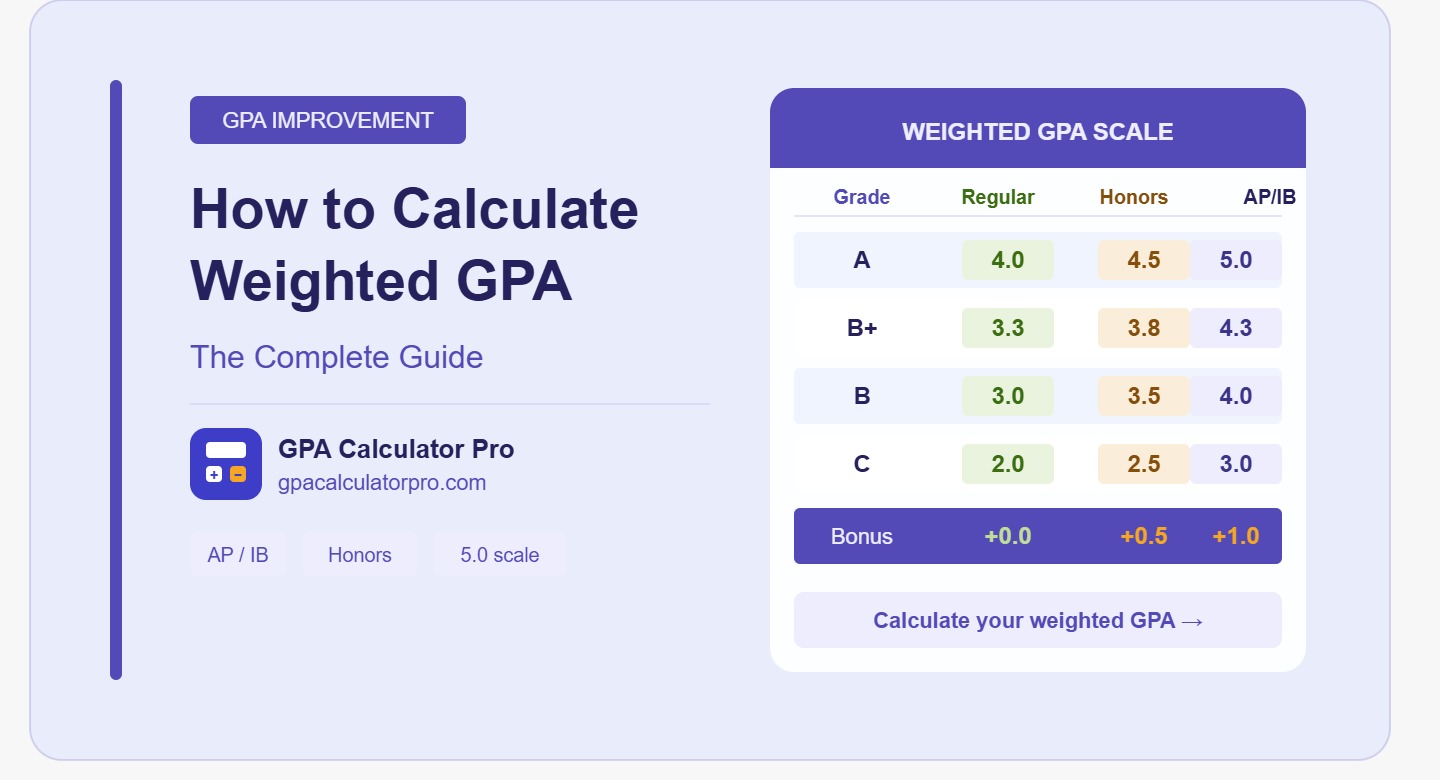
Most U.S. high schools use one of two weighting systems. The most common adds +0.5 for Honors and +1.0 for AP/IB courses to the standard grade points.
| Grade | Regular (4.0) | Honors (+0.5) | AP / IB (+1.0) |
|---|---|---|---|
| A / A+ | 4.0 | 4.5 | 5.0 |
| A− | 3.7 | 4.2 | 4.7 |
| B+ | 3.3 | 3.8 | 4.3 |
| B | 3.0 | 3.5 | 4.0 |
| B− | 2.7 | 3.2 | 3.7 |
| C+ | 2.3 | 2.8 | 3.3 |
| C | 2.0 | 2.5 | 3.0 |
| C− | 1.7 | 2.2 | 2.7 |
| D | 1.0 | 1.5 | 2.0 |
| F | 0.0 | 0.0 | 0.0 |
How to Calculate Weighted GPA - Step by Step
Step 1: List all your courses, grades, credits, and course level
You need four pieces of information for each course: the course name, your letter grade, the credit value (most high school courses are 1.0 credit), and whether it is Regular, Honors, or AP/IB.
Step 2: Convert each grade to weighted grade points
Use the table above. A B in an AP class = 4.0 weighted grade points. A B in a Honors class = 3.5. A B in a regular class = 3.0.
Step 3: Multiply grade points by credit hours
Quality Points = Weighted Grade Points × Credit Hours. For most high school courses with 1.0 credit, the quality points equal the grade points directly.
Step 4: Divide total quality points by total credits
Weighted GPA = Total Quality Points ÷ Total Credit Hours
Weighted GPA Calculation - Worked Example
Here is a full semester example with a mix of course levels:
| Course | Level | Grade | Weighted Points | Credits | Quality Points |
|---|---|---|---|---|---|
| English Literature | Regular | A | 4.0 | 1.0 | 4.0 |
| AP Calculus BC | AP | B+ | 4.3 | 1.0 | 4.3 |
| AP Biology | AP | A− | 4.7 | 1.0 | 4.7 |
| Honors US History | Honors | B | 3.5 | 1.0 | 3.5 |
| Spanish III | Regular | A | 4.0 | 1.0 | 4.0 |
| PE | Regular | A | 4.0 | 0.5 | 2.0 |
| TOTAL | 5.5 | 22.5 |
Your Weighted GPA
Unweighted GPA: (4.0 + 3.3 + 3.7 + 3.0 + 4.0 + 4.0) ÷ 5.5 = 22.0 ÷ 5.5 = 3.64
The difference: 4.09 weighted vs 3.64 unweighted. The AP and Honors courses added 0.45 GPA points to the weighted calculation, reflecting the extra difficulty of those courses.
How to Calculate Weighted GPA for High School
High school is where weighted GPA matters most. Most students' weighted GPA is calculated across all four years for the cumulative figure that appears on applications. Use our High School GPA Calculator to calculate both your weighted and unweighted GPA simultaneously - enter each course, your grade, credit value, and course level (Regular/Honors/AP) and both numbers appear instantly.
Does weighted GPA reset each year?
No - your cumulative weighted GPA runs across all four years continuously. Each year's grades are added to the running total. You can calculate an individual year's weighted GPA separately, but your official cumulative weighted GPA covers all completed coursework from 9th through 12th grade.
Can weighted GPA exceed 5.0?
Yes, theoretically. If a school uses a +1.0 bonus for AP/IB and a student takes exclusively AP courses and earns all A's, their weighted GPA would be 5.0. Some schools with different weighting systems allow GPA above 5.0. In practice, very few students sustain a 4.5+ weighted GPA across all four years.
Is Weighted or Unweighted GPA More Important?
For college admissions: unweighted GPA is more important as a direct comparison metric. Admissions officers cannot directly compare a 4.3 weighted GPA from one school with a 4.3 from another - different schools weight differently. Unweighted GPA on the 4.0 scale is the standardized comparison.
Where weighted GPA matters:
- Class rank: Many schools calculate class rank using weighted GPA, which is why taking AP courses can improve your rank even with the same grades as a student in regular courses
- Merit scholarships: Some scholarship programs use weighted GPA for eligibility thresholds
- Demonstrating rigor: A higher weighted GPA compared to your unweighted GPA shows an admissions officer that you challenged yourself - the gap between the two numbers tells a story
- Self-evaluation: Weighted GPA gives you a more accurate picture of your academic effort if you are in a demanding course load
Common Weighted GPA Questions
What is a good weighted GPA?
A weighted GPA above 4.0 is generally considered strong, since it indicates you are earning solid grades in advanced coursework. A 4.3–4.5 weighted GPA is excellent and signals a rigorous course load with consistently strong performance. Above 4.5 is outstanding and relatively rare.
How do colleges convert weighted GPA to their scale?
Most colleges recalculate your GPA themselves using their own formula when reviewing applications. They pull your raw grades from your transcript and apply their own weighting system - or strip weighting entirely and use only the 4.0 unweighted scale. This is why your self-reported weighted GPA on an application is often just supplementary information.
Do all high schools use the same weighted scale?
No - this is a key reason colleges standardize on unweighted GPA for comparison. Some schools use +0.5/+1.0. Others use +0.33/+0.67. Some include Dual Enrollment courses in weighting; others do not. If your school uses a non-standard system, check your transcript or contact your registrar for the exact weighting policy.
Does weighted GPA affect college GPA?
No. College GPA starts fresh in the first college semester on the standard 4.0 unweighted scale. High school weighted GPA has no direct bearing on your college GPA calculation. Once you start college, use our College GPA Calculator to track your college GPA separately from your high school record.
How do I raise my weighted GPA?
- Take more AP or Honors courses: Each additional advanced course you pass with a B or higher contributes more to your weighted GPA than the same grade in a regular course
- Prioritize grades in AP courses: A C in an AP class (2.3 + 1.0 = 3.3 weighted) is better than a C in regular (2.3) but a B+ in AP (3.3 + 1.0 = 4.3) is significantly better than a C in AP
- Use grade replacement where available: If your school allows retaking courses, a grade replacement in an AP course has compounding impact on weighted GPA
- Model different scenarios: Use our GPA Planning Calculator to see exactly what grades you need in remaining semesters to reach your weighted GPA target