Most finals study schedules fail before the first exam. Students build them based on equal time per subject, block in eight-hour study days, and abandon the whole thing by day two when life gets in the way.
A schedule that works is built differently - it starts with the math of what you actually need, not a general plan to “study everything.” Here is how to build one that reflects your real situation and that you will realistically stick to.
Calculate What You Actually Need Before You Schedule Anything
The single biggest mistake students make when building a finals schedule is skipping the calculation step. Before you assign a single study block, you need to know exactly what score you need on each final exam. Use our Final Grade Calculator for every course: enter your current grade, target grade, and exam weight. The result tells you the exact score required.
This step changes everything about how you build your schedule because it immediately separates your courses into clear priority levels.
| Required Score | Priority Level |
|---|---|
| 0% or negative | Locked - minimal review only |
| 1%–69% | Low - light review, don’t over-invest |
| 70%–84% | Medium - solid study block needed |
| 85%–94% | High - this exam matters, plan serious prep |
| 95%–100% | Critical - near-perfect needed, maximum focus |
| Above 100% | Redirect - target lower grade, study accordingly |
Map Your Exam Dates and Work Backwards
Once you know what each course needs, map your actual exam schedule and count the days available for each subject.
- List every exam: date, time, and required score
- Count days available before each exam: not total days in finals week - days specifically available before that exam
- Assign study sessions proportionally: high-stakes exams get more sessions, low-stakes exams get fewer, already-secured courses get none or one
- Leave a buffer day before each exam: one day of review only, no new material - this is non-negotiable
Concrete example for a student with four exams over six days:
Chemistry (Day 2, 88% required) → 3 sessions
English (Day 3, 52% required) → 1 session
Statistics (Day 5, 76% required) → 3 sessions
History (Day 6, 34% required) → 1 session
Chemistry gets the most sessions despite less available time because it has the highest required score. English and History get minimal time because the required scores are low.
Build Sessions, Not Hours
The most common scheduling mistake: blocking out eight hours and calling it a study day. Research on cognitive performance consistently shows that focused 90-minute sessions with breaks outperform marathon study sessions in both retention and output quality.
The session structure that works:
- Session length: 90 minutes of active study
- Break: 15–20 minutes - away from your desk, no phone scrolling
- Sessions per day: 2–3 maximum for sustainable performance
- Session start times: schedule them at specific times
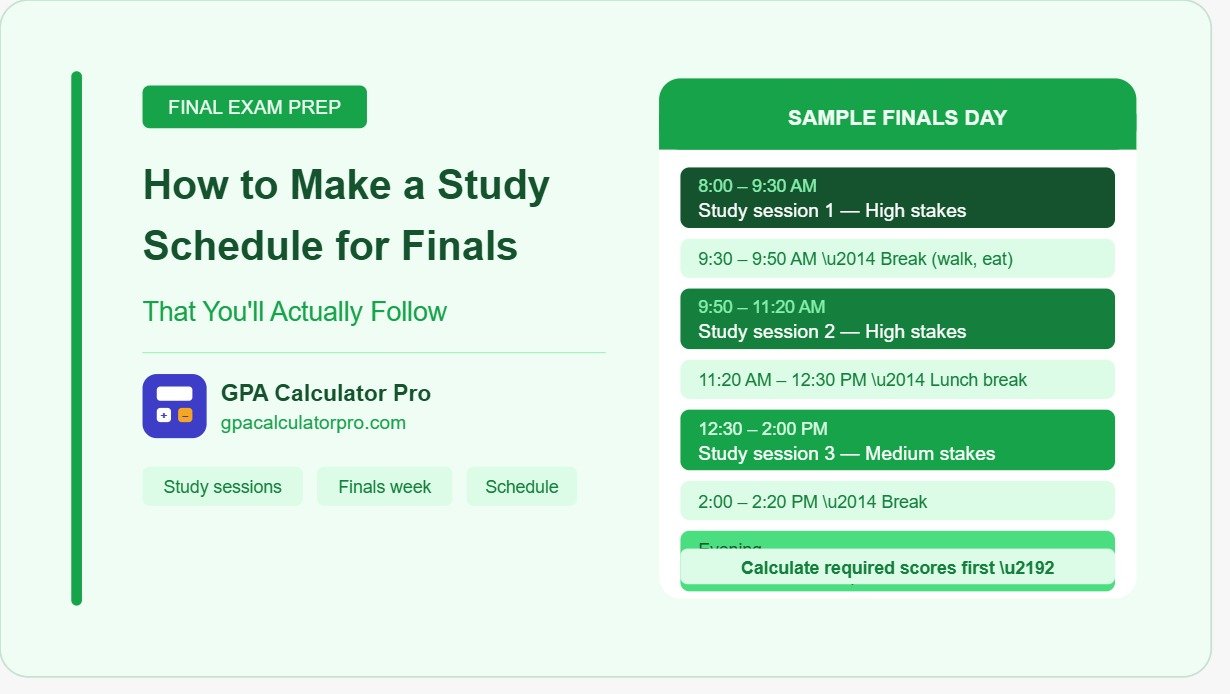
| Time | Activity |
|---|---|
| 8:00 – 9:30 AM | Study session 1 - High stakes |
| 9:30 – 9:50 AM | Break (walk, eat) |
| 9:50 – 11:20 AM | Study session 2 - High stakes |
| 11:20 AM – 12:30 PM | Lunch and real break |
| 12:30 – 2:00 PM | Study session 3 - Medium stakes |
| 2:00 – 2:20 PM | Break |
| Evening | Free time - protected, no guilt |
Assign Specific Tasks, Not Subjects
“Study Chemistry” is not a study session. “Complete practice problems 1–20 from Chapter 8” is a study session. The difference sounds minor but it determines whether you sit down and work or spend 20 minutes deciding what to do before giving up.
For each session block, write the specific task before finals week begins. Specific tasks have a clear end point. When the task is done, the session is done.
Use Active Study Methods, Not Passive Ones
What you do in each session determines how much you retain. Passive methods feel productive but have low retention rates.
Active methods that actually work:
- Flashcard self-testing: write the question, test yourself, flag missed cards, retry only the missed ones
- Blank page recall: close all notes, write down everything you remember about a topic, then check what you missed
- Practice problems: especially for math, science, economics - do the problems without looking at examples
- Teaching out loud: explain a concept as if teaching someone else
- Past exams: the closest proxy to the actual test
The Finals Week Schedule Template
Run the Final Grade Calculator for every course. List all exam dates. Assign sessions proportionally by required score. Write specific tasks for each session. Identify your two highest-stakes exams.
Begin content review for your highest-stakes exam first. Active recall only. Complete at least one past exam for each high-stakes course. Flag weak topics.
2–3 sessions per day maximum - protect the evening. Day before each exam: review only. Night before: confirm exam details, prepare everything, sleep well.
Common Finals Schedule Mistakes to Avoid
❌ Don’t
- Give equal time to every subject
- Schedule study right up to the exam morning
- Use vague tasks like “study chapter 5”
- Study with people who increase your anxiety
- Skip scheduled breaks
✅ Do
- Allocate time by required score
- Leave a buffer day before each exam
- Write specific tasks with clear end points
- Protect your evening and sleep
- Treat breaks as mandatory
After Finals - Check Your Actual GPA
Once grades post, recalculate your GPA immediately. Use our Semester GPA Calculator to see where this semester lands, then check your updated cumulative GPA with our Cumulative GPA Calculator. Knowing the real number after finals tells you exactly what next semester needs to look like.