Medical school is the most GPA-sensitive graduate pathway in the United States. Unlike MBA or law school admissions, where a strong GMAT or essay can meaningfully offset a lower GPA, medical school admissions committees treat GPA as a hard signal of academic readiness - and they evaluate two numbers, not one.
This guide covers exactly what GPA you need, why science GPA is evaluated separately, what the average applicant looks like, and what you can still do if your GPA is below the competitive range.
The Two GPAs Medical Schools Evaluate
Medical schools do not look at just one GPA. They evaluate two separately: your overall GPA and your science GPA (also called BCPM GPA). Both appear on your AMCAS application and both carry significant weight in admissions decisions.
Overall GPA: your cumulative grade point average across every course you have taken in college - sciences, humanities, electives, everything. This is calculated on the standard 4.0 scale and reflects your total academic record.
Science GPA (BCPM): calculated only from your Biology, Chemistry, Physics, and Math courses. This is the GPA that directly measures your readiness for the rigorous basic science curriculum of the first two years of medical school. A student with a 3.8 overall but a 3.2 science GPA will face serious scrutiny.
Before doing anything else, calculate both figures precisely. Use our Cumulative GPA Calculator to get your overall GPA, then run your BCPM courses separately to get your science GPA. Knowing both numbers is the starting point for every other decision in this guide.
What GPA Do You Need for Medical School?
The short answer: 3.5 is the realistic floor for competitive applicants. 3.7+ is where you are genuinely competitive for most MD programs. Here's what the data shows:
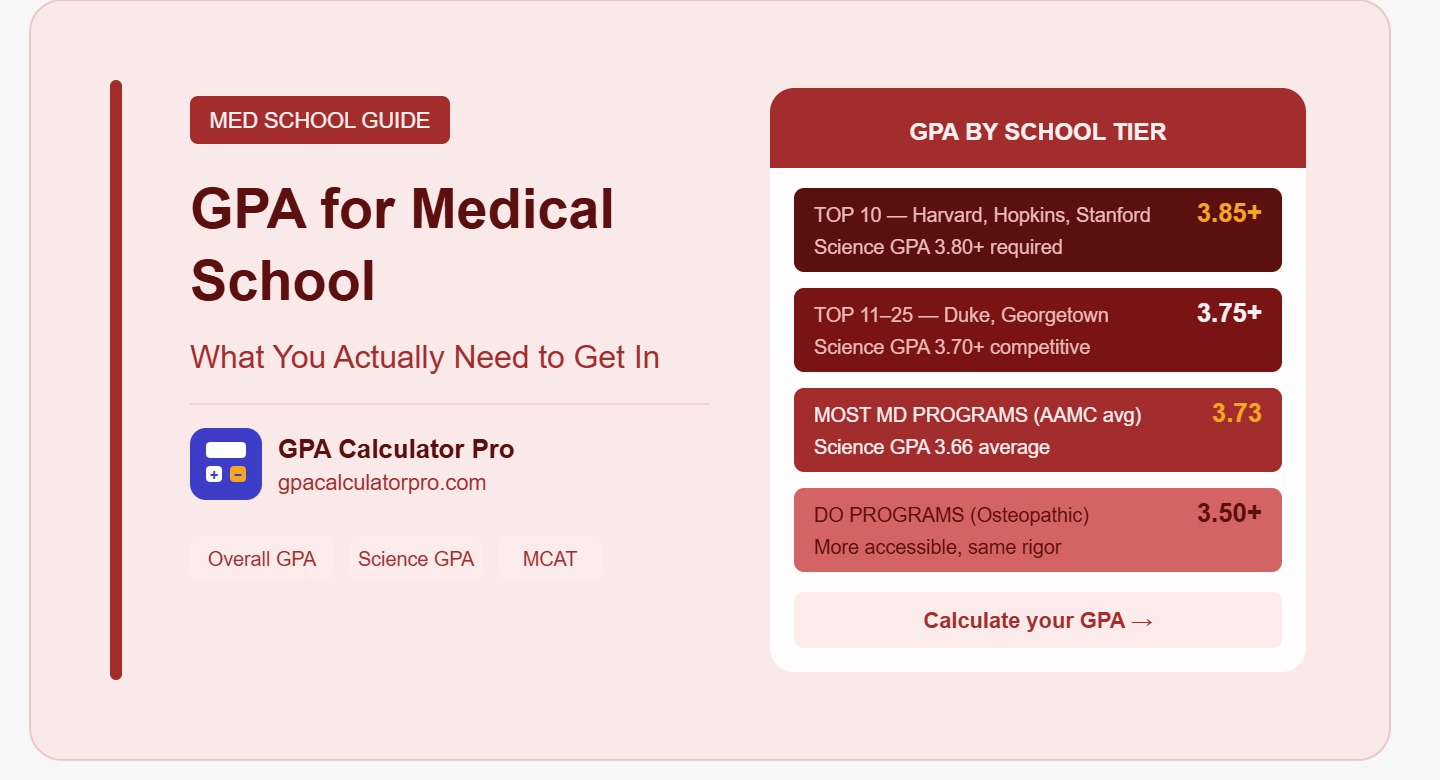
Top 10 - Harvard, Hopkins, Stanford 3.85+
Science GPA 3.80+ required. These schools are highly selective and rarely accept below this range.
Top 11–25 - Duke, Georgetown 3.75+
Science GPA 3.70+ competitive. Strong MCAT and research experience essential.
Most MD Programs (AAMC average) 3.73
Science GPA 3.66 average. Realistic target for most allopathic programs.
DO Programs (Osteopathic) 3.50+
More accessible, same rigor. 3.5 is competitive at many programs.
Is a 3.5 GPA Good for Medical School?
A 3.5 GPA is at the lower edge of competitive for most MD programs - it gets you in the door, but it is not comfortable. At the average MD program, the accepted applicant has a 3.73 GPA. A 3.5 puts you 0.23 below the average, which means every other part of your application - MCAT score, research experience, clinical hours, letters of recommendation - needs to be strong to compensate.
For DO (osteopathic) programs, a 3.5 is genuinely competitive. For MD programs, it depends heavily on your MCAT score. A 3.5 GPA paired with a 515+ MCAT is a viable application. A 3.5 GPA with a 505 MCAT is a very difficult application at most allopathic programs.
Is a 3.7 GPA Good for Medical School?
Yes - a 3.7 GPA is genuinely competitive for most MD programs in the United States. It places you above the national average for accepted applicants at many programs and within striking distance of the average at the top 25. With a strong MCAT score (512+), a 3.7 gives you a legitimate application to a wide range of allopathic programs.
A 3.7 overall GPA with a 3.7+ science GPA is a strong foundation. Where the 3.7 starts to feel limited is at the very top programs - Harvard, Hopkins, Stanford, and similar institutions where the median accepted GPA is 3.85+. At those schools, a 3.7 needs to be accompanied by exceptional research, publications, or other distinguishing factors.
Minimum GPA for Medical School
Most MD programs publish a stated minimum GPA, typically 3.0. In practice, the functional minimum - the GPA below which your application is unlikely to receive serious review at most programs - is higher. Very few accepted students at top programs have GPAs below 3.4.
Science GPA - Why It Matters as Much as Overall GPA
Many applicants focus entirely on their overall GPA without realizing that admissions committees weight science GPA heavily - sometimes more than overall GPA for borderline applications.
The BCPM courses (Biology, Chemistry, Physics, Math) are considered direct predictors of performance in the first two years of medical school, which are dominated by basic sciences. Here is what different scenarios look like:
| Scenario | How It Reads |
|---|---|
| 3.7 overall, 3.7 science | Strong across the board - consistent performance, no red flags |
| 3.7 overall, 3.4 science | Concerning - suggests the GPA is carried by non-science electives; questions readiness for basic science curriculum |
| 3.5 overall, 3.7 science | Actually reads better than the reverse - strong in courses that predict medical school success |
| 3.4 overall, 3.4 science | Difficult at most MD programs - post-bacc or SMP recommended before applying |
GPA Trends - What Upward Trajectory Does For Your Application
Medical school admissions committees review your grade transcript year by year, not just as a final number. An upward trend - where performance clearly improves from freshman to senior year - is interpreted positively, even when the cumulative GPA is below average.
Conversely, a downward trend - strong early performance that declines - is treated as a red flag even when the cumulative GPA is above 3.5. It raises questions about burnout, commitment, or inability to handle increasing difficulty.
What to Do If Your GPA Is Below the Competitive Range
Post-Baccalaureate Programs
A formal post-bacc program (typically 1–2 years of upper-division science coursework) is the most recognized GPA repair pathway. Strong performance (3.7+ in post-bacc science courses) demonstrates to admissions committees that the original GPA does not reflect current ability. Many post-bacc programs have linkage agreements with medical schools.
Special Master's Programs (SMP)
An SMP is a 1-year master's program taken alongside first-year medical students, using the same curriculum and often graded on the same curve. An A or B in an SMP is interpreted as direct evidence of medical school readiness. For applicants below 3.3, an SMP is often more effective than a post-bacc.
Grade Replacement in Remaining Undergrad Semesters
If you are still in college, every semester remaining matters. Model what grades you need to reach your target GPA using our GPA Planning Calculator. For students approaching finals, calculate the exact exam score needed in each course to hit your target course grade - then allocate study time to the courses where improvement is still mathematically possible.
MCAT and GPA - How They Work Together
GPA and MCAT are evaluated together, not independently. Admissions committees use both to build a picture of academic readiness. The relationship between the two matters: a high MCAT score (515+) can strengthen a borderline GPA application, but it cannot erase a low GPA. Similarly, a strong GPA with an average MCAT will limit your options at highly selective programs.
Frequently Asked Questions
What GPA do you need for medical school?
The functional minimum for competitive MD applications is 3.5, with 3.7+ making you competitive at most programs. The AAMC reports the average accepted applicant GPA at 3.73 overall and 3.66 science. DO programs typically accept applicants with GPAs in the 3.4–3.6 range.
Does science GPA matter more than overall GPA?
Both matter, but admissions committees pay particular attention to science GPA (BCPM) because it directly predicts performance in the basic science years. A low science GPA is harder to explain than a low overall GPA, because non-science electives can drag overall GPA down in ways that do not reflect science readiness.
Can I get into medical school with a 3.0 GPA?
It is very difficult at MD programs. Below 3.0 is below the stated minimum at most allopathic medical schools. DO programs are more accessible but still require a strong MCAT score. A post-bacc or SMP program is the most realistic pathway for applicants below 3.2 who want to pursue medicine.
Is a 3.5 GPA good enough for medical school?
For DO programs, yes - 3.5 is competitive. For MD programs, 3.5 is at the lower edge of the competitive range. It requires a strong MCAT (512+), strong clinical experience, and a carefully constructed school list that includes programs where your GPA is at or above the average for admitted students.
How do medical schools calculate GPA?
AMCAS (the central medical school application) recalculates your GPA using its own formula, which may differ from your university's calculation. It includes all attempted coursework, including repeated courses (both grades count - AMCAS does not allow grade replacement). Calculate your baseline cumulative GPA with our College GPA Calculator to understand your starting point, then check the AMCAS GPA calculator for your official figure.
What if I have a low GPA but high MCAT?
A high MCAT score (515+) helps significantly but does not erase a low GPA. Admissions committees view GPA as a sustained measure of academic performance and MCAT as a single-point measure. A 3.3 GPA with a 520 MCAT is a better application than a 3.3 GPA with a 505, but most committees will still flag the GPA and want an explanation or a post-bacc/SMP to address it.