You've calculated your CGPA. You know your percentage equivalent. Now a job application form asks for one specific number - and you're not sure which one recruiters actually want to see, or whether it even matters. The honest answer: it depends on the industry, the company, and increasingly, on nothing at all. Here's exactly where each format still matters and where it doesn't.
The Quick Answer
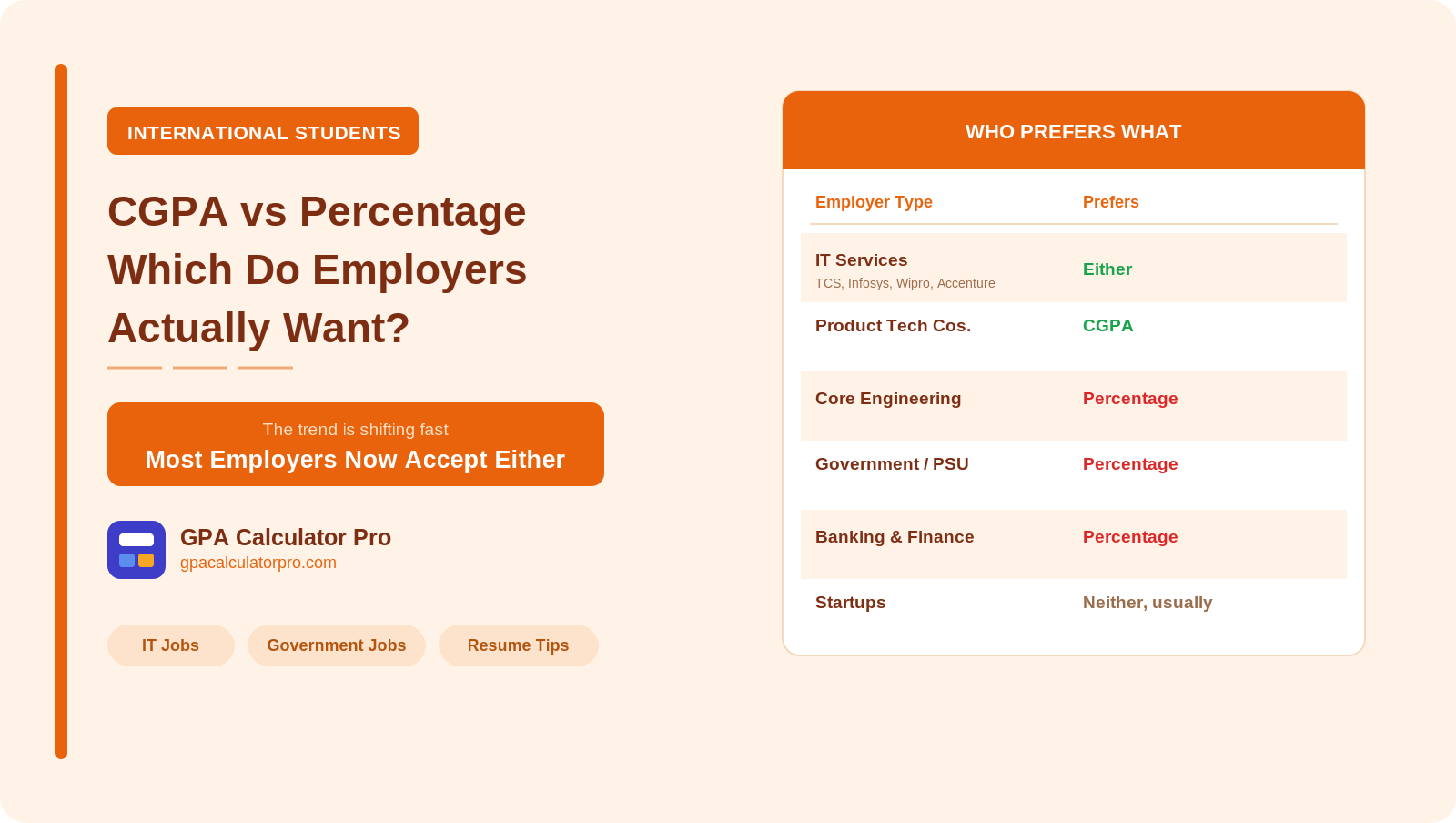
Most large Indian employers now accept CGPA directly - the shift away from requiring percentage has been steady over the last decade. But older application systems, government forms, and some traditional sectors still default to percentage. Here's the pattern by employer type:
| Employer Type | Typical Preference | Notes |
|---|---|---|
| IT services (TCS, Infosys, Wipro, Accenture) | Either - CGPA increasingly standard | Cutoffs often stated as "60% or 6.0 CGPA" - both accepted |
| Product-based tech companies | CGPA | Younger application systems built around CGPA from the start |
| Core engineering / manufacturing | Percentage | Older, more traditional HR systems and forms |
| Government / PSU recruitment | Percentage | Official notifications almost always specify percentage |
| Banking & finance | Percentage | Conservative sector; forms often still percentage-only |
| Startups | Neither, usually | Portfolio and skills typically matter more than either format |
Why This Question Even Comes Up
Percentage was the universal standard for decades under CBSE and most state boards. CGPA was introduced later - first in schools, then adopted by many universities and technical institutes - as a way to reduce the pressure of marginal percentage differences between students. The result: a generation of application forms, HR systems, and recruiter habits built around percentage that haven't fully caught up to CGPA becoming the norm at the university level. That gap is closing, but it hasn't closed everywhere.
IT and Tech Companies - What They Actually Ask For
Most large IT services firms and product companies now accept CGPA directly on application forms, and many campus recruitment portals list eligibility as "6.0 CGPA or 60%" side by side. If a specific field only accepts one format, use our SGPA to CGPA Calculator to get your precise CGPA first, then convert using your university's official multiplier - never a generic online estimate for a formal application.
Where Percentage Still Dominates
Three areas where you should expect percentage-only forms, regardless of how your university reports your CGPA:
- Government and PSU recruitment: Official notifications for GATE-based PSU hiring, banking exams (IBPS, SBI), and most state government roles specify percentage cutoffs explicitly, even when your degree was awarded on a CGPA scale.
- Core engineering and manufacturing firms: Many established manufacturing, infrastructure, and traditional engineering companies still run older HR systems built around percentage-only fields.
- Study-abroad and visa documentation: Some visa and immigration forms ask for percentage equivalence specifically - not because CGPA is invalid, but because their systems were built before CGPA-reporting universities became common.
How to Convert Accurately When a Form Forces One Format
Never use a generic multiplier for formal documents. The conversion formula varies meaningfully by university:
| University / Board | Formula | Example (CGPA 8.0) |
|---|---|---|
| CBSE / most central universities | Percentage = CGPA × 9.5 | 76% |
| VTU | Percentage = (CGPA − 0.75) × 10 | 72.5% |
| Anna University | Percentage = (CGPA − 0.5) × 10 | 75% |
| Mumbai University | Percentage = (CGPA − 0.5) × 10 | 75% |
For the complete university-wise breakdown and worked examples, see our full guide: CGPA to Percentage - How to Convert with Formula and University-Wise Guide.
Should You List Both on Your Resume?
Yes - when the form allows free text, listing both removes any ambiguity for the recruiter and avoids a mismatch if they cross-check your transcript. Format it clearly: "CGPA: 8.2 (76% equivalent, per [university] official formula)." This is especially useful for recruiters unfamiliar with your specific university's grading system, and it signals precision rather than guesswork.
Does It Actually Matter Which One You Lead With?
For most recruiters, no - once your number clears whatever cutoff applies, the format you led with rarely changes the outcome. What matters more: that the number is accurate, verifiable against your official transcript, and consistent everywhere you report it - resume, application form, and any background check documentation. A recruiter is far more likely to flag an inconsistency between two different self-reported numbers than to care whether you led with CGPA or percentage.
Frequently Asked Questions
Do Indian companies prefer CGPA or percentage?
Is CGPA the same as percentage?
How do I convert CGPA to percentage for a job application?
What if the application form only has a percentage field but my degree uses CGPA?
Does it look bad to report CGPA when percentage is more common in my field?
Ready to Confirm Your Exact CGPA?
Calculate your precise cumulative CGPA, then convert it accurately for any application.
Convert My CGPA Now