"Is my CGPA good?" is one of the most common questions Indian students ask - and the honest answer is that it depends entirely on what you're using it for. A 7.5 CGPA is genuinely strong for one goal and merely average for another. This guide breaks it down by range, by campus placement expectations, by higher-studies requirements, and by government exam cutoffs, so you know exactly where your number stands.
What Counts as a Good CGPA? - Quick Reference
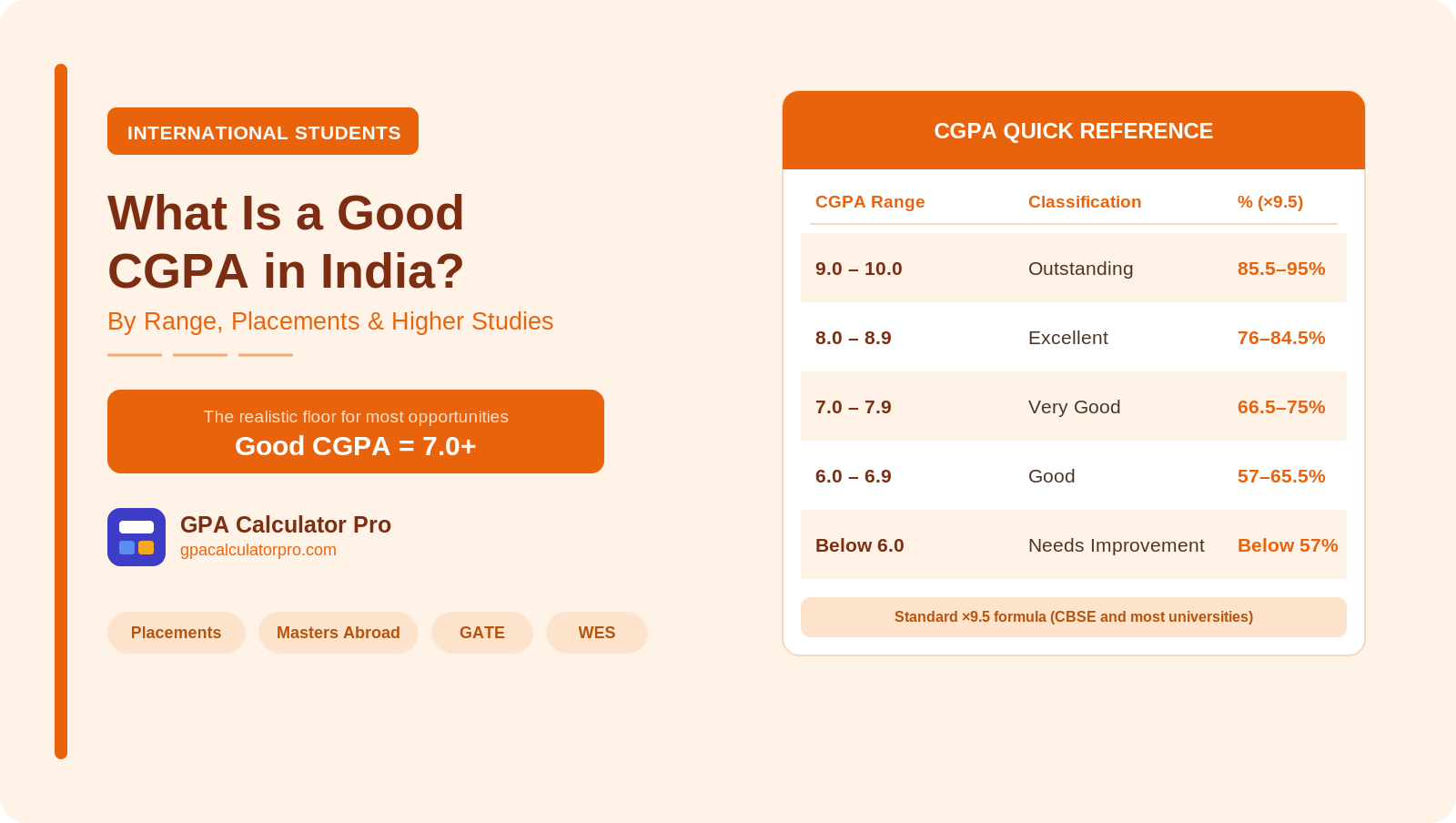
CGPA in India is measured on a 10-point scale. Here's how each range is generally viewed, along with the percentage equivalent using the standard ×9.5 formula.
| CGPA Range | Classification | Percentage (×9.5) | What It Typically Opens |
|---|---|---|---|
| 9.0 – 10.0 | Outstanding | 85.5% – 95% | Top recruiters, elite postgrad programs, gold medals |
| 8.0 – 8.9 | Excellent | 76% – 84.5% | Strong for most campus placements and Masters abroad |
| 7.0 – 7.9 | Very Good | 66.5% – 75% | Meets most placement and postgrad eligibility criteria |
| 6.0 – 6.9 | Good | 57% – 65.5% | Meets minimums; may limit access to top recruiters |
| Below 6.0 | Needs Improvement | Below 57% | May restrict eligibility for some placements/programs |
Use our SGPA to CGPA Calculator to confirm your exact, credit-weighted CGPA before comparing it against any of the benchmarks below - a rough estimate can be misleading by several tenths.
Is a 7.0 CGPA Good in India?
Yes - a 7.0 CGPA is solidly good and meets the eligibility bar for the large majority of campus placements and postgraduate programs. It corresponds to roughly 66.5% using the standard conversion, placing you in the "First Class" category at most universities. It won't stand out at the most selective recruiters or top-ranked institutes, but it is not a limiting number for most paths.
Is an 8.0 CGPA Good in India?
Yes - an 8.0 CGPA is excellent and competitive for nearly every campus recruiter and most postgraduate programs, in India and abroad. At roughly 76%, it crosses the "First Class with Distinction" threshold at most institutions and converts to approximately a 3.2 US GPA - a strong figure for international Masters applications.
Is a 9.0 CGPA Good in India?
Yes - a 9.0 CGPA is outstanding. It places you in the top tier of your cohort at almost any Indian institution, corresponds to roughly 85.5%, and converts to approximately a 3.6 US GPA. This level is genuinely competitive for the most selective employers, scholarships, and graduate programs worldwide.
What CGPA Do You Need for Campus Placements?
Placement CGPA cutoffs vary significantly by company type and role. Here's the general pattern seen across Indian campus recruitment:
| Recruiter Type | Typical Minimum CGPA | Notes |
|---|---|---|
| IT services (TCS, Infosys, Wipro, Accenture) | 6.0 – 6.5 | Often stated as "60% or 6.0 CGPA"; among the most accessible cutoffs |
| Core engineering / PSUs | 6.5 – 7.0 | Some PSU recruitment (via GATE) has stricter eligibility rules |
| Product-based tech companies | 7.0 – 7.5 | Often paired with strong problem-solving rounds regardless of CGPA |
| Consulting & Big 4 | 7.0 – 7.5 | CGPA is an initial filter; case rounds matter heavily after |
| Investment banking / top consulting | 8.0+ | Most selective end of campus recruitment |
If you're below a target company's stated cutoff, check whether it's a hard filter or a guideline - some recruiters make exceptions for strong project work, internships, or coding-round performance. Track your standing with our Cumulative GPA Calculator so you know your exact number heading into placement season.
What CGPA Do You Need for Higher Studies Abroad?
For Masters programs in the US, UK, Canada, or Australia, your CGPA is typically converted to that country's scale before evaluation.
This ×0.4 formula is a widely used approximation, not an official standard - many programs require a formal evaluation through WES or a similar credential evaluator. For the full formula, university-wise percentage conversions, and how admissions committees actually read your CGPA, see our guide: How to Convert Your CGPA to a US GPA.
What CGPA Do You Need for Government Exams and PSU Recruitment?
Eligibility rules vary by exam and organisation, but a few patterns are consistent:
- Most PSU recruitment via GATE requires a minimum of 60% or 6.5 CGPA in your qualifying degree - always confirm against the specific PSU's notification.
- UPSC and most state PSC exams do not set a CGPA/percentage cutoff for eligibility - a bachelor's degree from a recognised university is generally sufficient.
- Banking exams (IBPS, SBI) typically require only a pass in your qualifying degree, with no CGPA threshold in most notifications.
Always verify against the specific exam's official notification - cutoffs and rules are updated yearly and vary by category and post.
Does the University You Attend Change What "Good" Means?
Yes. A 7.5 CGPA from an IIT or NIT is read differently than a 7.5 from a less competitive institution - recruiters and admissions committees familiar with Indian grading patterns factor in institutional rigor, not just the raw number. This is especially relevant for international applications, where a mention of your institution's grading reputation in your application can add useful context alongside the number itself.
Frequently Asked Questions
What is considered a good CGPA in India?
Is 7.5 CGPA good for placements?
What is the average CGPA in India?
Is 6 CGPA good or bad?
Does CGPA matter after getting a job?
Ready to Calculate Your Exact CGPA?
Convert SGPA to CGPA, then see exactly where your number stands.
Convert My CGPA Now