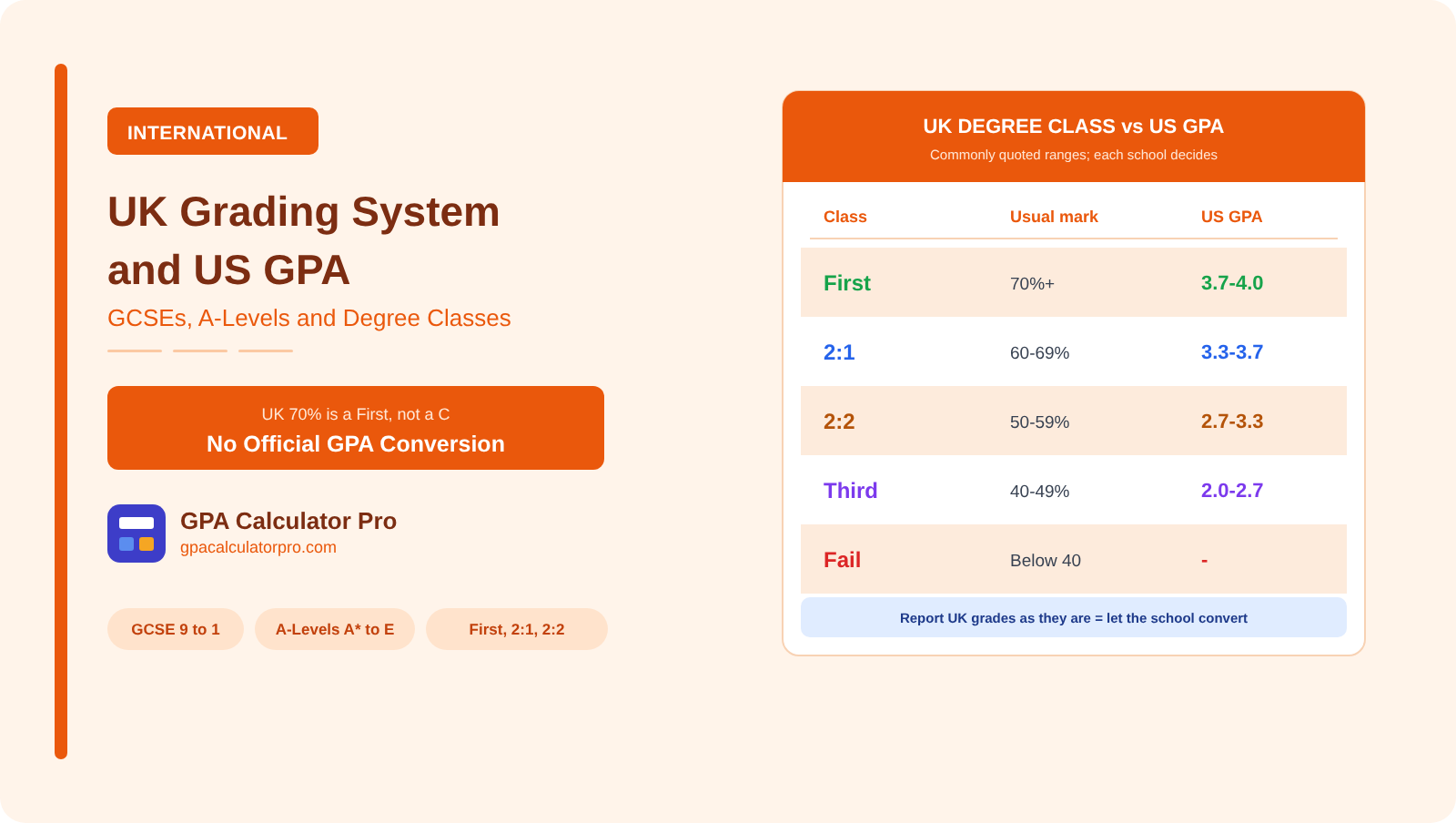
The UK grading system uses a different scale at each stage. GCSEs, taken at about 16 in England, are graded with numbers from 9 (highest) to 1. A-levels, taken at about 18, use letters from A* to E. University bachelor's degrees end with a degree class: a First, a 2:1, a 2:2 or a Third. None of these is a GPA, and there is no official conversion to the US 4.0 scale.
This guide explains each stage, what counts as a pass, and how US universities usually compare British grades with a GPA. Rules differ slightly in Scotland, Wales and Northern Ireland; the GCSE scale below is the one used in England.
UK Grades at a Glance
| Stage | Grades | Top / pass |
|---|---|---|
| GCSE Age about 16 | 9 to 1, then U | 9 / 4 standard pass |
| A-level Age about 18 | A* to E, then U | A* / E |
| Degree Honours bachelor's | First, 2:1, 2:2, Third | First / Third |
The biggest difference from the US system is that UK grades are mostly earned in end-of-course exams rather than built up from homework, quizzes and coursework throughout the year. That is one reason UK percentages look low by American standards.
GCSE 9 to 1 Explained
GCSEs in England moved from letters (A* to G) to numbers (9 to 1) in 2017. The two scales are not identical, but Ofqual, the exams regulator, lined them up at three points:
| 9 to 1 grade | Old letter grade | Meaning |
|---|---|---|
| 9, 8 | Above A / A* | Top grades |
| 7 | Bottom aligned with A | High grade |
| 5 | High C / low B | Strong pass |
| 4 | Bottom aligned with C | Standard pass |
| 1 | Bottom aligned with G | Lowest grade |
| U | U | Ungraded |
The 7, 4 and 1 rows are the official alignment points. Grade 5 as "high C / low B" is AQA's description. A U means the paper did not reach grade 1.
- Grade 4 is a "standard pass" in every subject and marks a similar achievement to the old grade C or above.
- Grade 5 is a "strong pass" and is the headline measure for English and maths in school performance tables.
- Grade 9 is the highest. It is set above the old A* standard, to pick out the very top performers.
So a 7 at GCSE is broadly an A, and a 4 is broadly a C. Grades are awarded per subject; there is no overall GCSE average.
A-Levels
Most students in England take three A-levels in their final two years of school. Each is graded separately:
| A-level grade | UCAS points | Status |
|---|---|---|
| A* | 56 | Pass (top) |
| A | 48 | Pass |
| B | 40 | Pass |
| C | 32 | Pass |
| D | 24 | Pass |
| E | 16 | Pass (lowest) |
| U | 0 | Ungraded (fail) |
Every grade from A* to E is a pass, and U is the only fail. UK universities often state offers in grades (for example AAB) or in UCAS Tariff points, which turn grades into numbers so different qualifications can be compared.
University Degree Classes
A UK honours bachelor's degree, usually three years in England, is awarded with an overall class based on your weighted average mark. The University of York's scale is typical:
| Class | Usual mark | Short name |
|---|---|---|
| First class honours | 70+ | First |
| Upper second class | 60‑69 | 2:1 |
| Lower second class | 50‑59 | 2:2 |
| Third class honours | 40‑49 | Third |
| Fail | Below 40 | - |
A 2:1 is said "two-one" and a 2:2 "two-two". Many UK employers and master's programmes ask for at least a 2:1.
Why the final year matters most
Universities usually weight later years more heavily, and the exact weighting is set in each university's regulations. As an illustration, suppose a student averages 62 in their second year and 71 in their final year. If the university weights them 40 and 60 percent, the overall mark is 67.4, a 2:1. Weighted one-third and two-thirds, it is 68.0, still a 2:1, even though the final year alone was First-class. Many universities also have rules for students just below a boundary, so read your own regulations.
UK to US GPA: Typical Equivalents
There is no official conversion between UK grades and a US GPA. The ranges below are the ones most often quoted for degree classes, and Save My Exams attributes this table to the Fulbright Commission, the US-UK educational exchange body:
| UK degree class | Commonly quoted US GPA |
|---|---|
| First | 3.7‑4.0 |
| 2:1 | 3.3‑3.7 |
| 2:2 | 2.7‑3.3 |
| Third | 2.0‑2.7 |
Treat these as a starting point only. A strong First from a demanding course and a borderline First can be read differently, and each US university or evaluator makes its own judgement. For school-level grades, US colleges usually read GCSEs and A-levels as they are rather than converting them.
Why Conversions Differ
- Different marking cultures. UK examiners rarely award marks in the 80s and 90s for essay subjects, while US courses often give A grades for 90 percent and above.
- Exams versus continuous grading. A UK result often rests on a few final exams; a US GPA averages many graded pieces of work.
- Different weightings. UK degree classes weight later years more; a US GPA usually counts every course by its credit hours.
- Each evaluator has its own method. Two services can give the same transcript slightly different GPAs.
Applying to the US With UK Grades
- Report grades as they are. Enter your GCSE numbers, A-level letters or degree class exactly as shown on your certificates or transcript, unless the application tells you to convert them.
- Check whether an evaluation is required. Some US graduate schools ask for a course-by-course credential evaluation, which states a US-equivalent GPA. Order the one each school names.
- Know the usual bar. Many US graduate programmes set a minimum of about 3.0, which UC Berkeley, for example, describes as a B average. A 2:1 or better is generally the safe target.