The valedictorian is the student ranked first in the graduating class, and the salutatorian is the student ranked second. Traditionally, the salutatorian opens the graduation ceremony with a welcome speech and the valedictorian closes it with a farewell. There is no national rule for choosing them: each school or district sets its own policy, and many rank students by weighted GPA.
This guide explains what the two titles mean, how real districts pick them, why weighting can change the result, and what happens with ties.
Valedictorian vs Salutatorian at a Glance
| Valedictorian | Salutatorian | |
|---|---|---|
| Class rank | 1st | 2nd |
| Speech | Valedictory (farewell) | Salutatory (welcome) |
| Latin root | vale dicere, "to say farewell" | salutare, "to greet" |
| Usual order | Speaks last | Speaks first |
Merriam-Webster defines the valedictorian as "the student usually having the highest rank in a graduating class" who gives the valedictory address, and the salutatorian as the student "usually having the second highest rank" who gives the salutatory address. The word "usually" matters: the titles follow each school's own rules, which can add requirements beyond grades.
So if you are wondering what comes after valedictorian, it is salutatorian. Below that, schools usually just list class rank or honor-roll levels.
How Schools Choose the Valedictorian
The selection is a written policy, usually set by the school board. Two real examples show the kinds of rules you will find.
Austin ISD, Texas
- Ranking: class rank is based on weighted GPAs in courses that satisfy the student's graduation plan, in English, math, science, social studies and languages other than English.
- Eligibility: the top two students must earn the distinguished level of the Foundation High School Program, meet all course requirements, and have attended the same district high school continuously for the two years before graduation.
Johnstown High School, New York
- Ranking: the valedictorian has the highest cumulative GPA, calculated to the tenth of a percent. Students are ranked at the end of the third marking period of senior year.
- Eligibility: students must have been at the school for the two years before graduation and must finish high school within four years.
Weighted or Unweighted GPA?
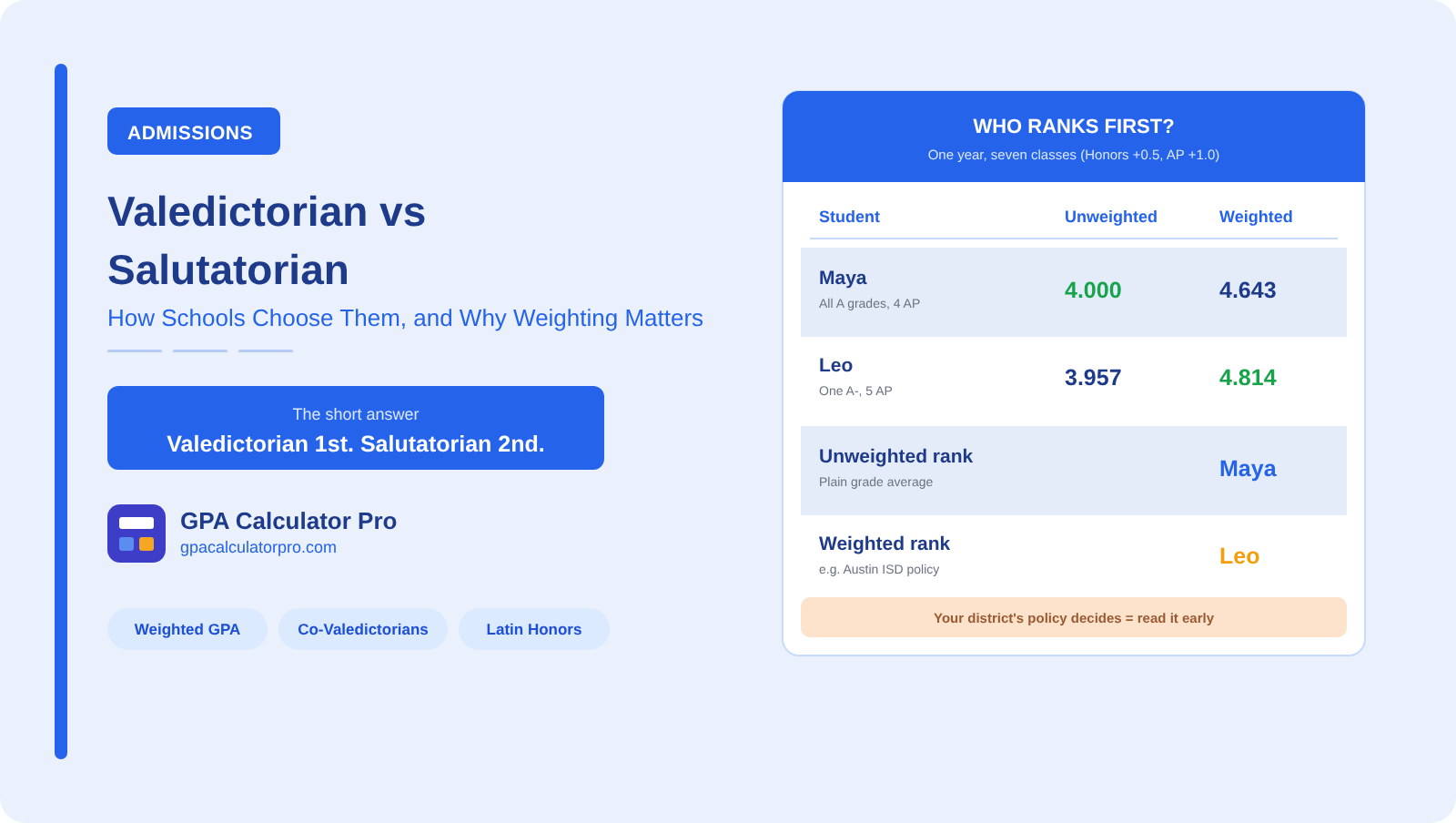
When a school ranks by weighted GPA, harder classes count for more. On a common scale, honors classes add 0.5 and AP or IB classes add 1.0 to each grade, which is how weighted GPAs climb above 4.0. That means the student with the most A grades is not always first. Here is one year of seven classes for two students:
| Student | Unweighted | Weighted |
|---|---|---|
| Maya 7 A grades: 4 AP, 1 honors, 2 regular | 4.000 | 4.643 |
| Leo 6 A grades + 1 A-: 5 AP, 2 honors | 3.957 | 4.814 |
Grades use A = 4.0 and A- = 3.7, with +0.5 for honors and +1.0 for AP, the same weighting as our High School GPA Calculator. Your school's bonus points may differ.
Maya has the perfect unweighted GPA, but Leo took one more AP class and one more honors class. Under a weighted ranking like Austin ISD's, Leo ranks higher despite his A-. Under an unweighted ranking, Maya would. To see how the bonuses work in detail, read how to calculate weighted GPA.
What GPA Does It Take to Be Valedictorian?
There is no set number. The valedictorian is whoever ranks first, so the GPA it takes depends entirely on your classmates and on how your school weights classes. At a school that ranks by weighted GPA and offers many AP courses, the top GPA can sit well above 4.0. At a school that uses an unweighted average, it can be a perfect 4.0 or very close to it.
If you are aiming for the title, the practical steps follow from the policy:
- Find out whether rank uses weighted or unweighted GPA, and which courses count. Austin ISD, for example, counts only core subjects.
- If rank is weighted, plan your schedule early. Weighted classes taken in 9th and 10th grade count just as much as later ones.
- Check the cutoff date. At Johnstown, the ranking is set after the third marking period of senior year, so later grades do not change it.
- Check enrollment rules before changing schools. Both policies above require two years at the same school.
You can test different schedules in the High School GPA Calculator to see how much each AP or honors class moves your weighted GPA.
Ties and Multiple Valedictorians
Ties happen when students finish with exactly the same GPA, for example straight A grades in the same weighted classes. Good policies say in writing what happens next:
| School | What happens in a tie |
|---|---|
| Austin ISD (TX) | Tie for 1st: co-valedictorians, and no salutatorian is named. Tie for 2nd: co-salutatorians. |
| Johnstown HS (NY) | Tie for 1st: co-valedictorians. Tie for 2nd: co-salutatorians. |
Some schools name several co-valedictorians in a year.
Why Some Schools Have Dropped the Titles
A number of districts have replaced valedictorian, salutatorian and class rank with Latin honors that any student can reach by meeting a GPA level:
- Virginia Beach City Public Schools dropped class rank and both titles starting with the class of 2022. Graduates now earn Honor Graduate (3.0 to 3.49), cum laude (3.5 to 3.75), magna cum laude (3.76 to 3.99) or summa cum laude (4.0 and above).
- St. Paul Public Schools in Minnesota moved to a weighted-GPA Latin honors system, saying the change would let them celebrate the successes of more students.
The idea is the same as college Latin honors, which are explained in what is cum laude.
Do Colleges Have Valedictorians?
Most US colleges recognize top graduates through Latin honors rather than a single valedictorian. Some still name one. At Princeton, the faculty accepts nominations from its Faculty Committee on Examinations and Standing, and the salutatorian traditionally delivers the salutatory oration in Latin.
Does Being Valedictorian Help With College Admissions?
Colleges see the evidence behind the title: your GPA, the difficulty of your classes and, if your school reports it, your class rank. On the Common App, class rank is an optional field, and some schools do not report rank at all. So being valedictorian helps mostly because of the grades and course choices that earned it. For how admissions offices weigh GPA and rank, see does high school GPA matter for college?
The title can also bring direct rewards. In Texas, the highest-ranking graduate of an accredited high school can get a tuition waiver for both semesters of the first year at a Texas public college or university. It covers tuition only, not fees, books or housing.