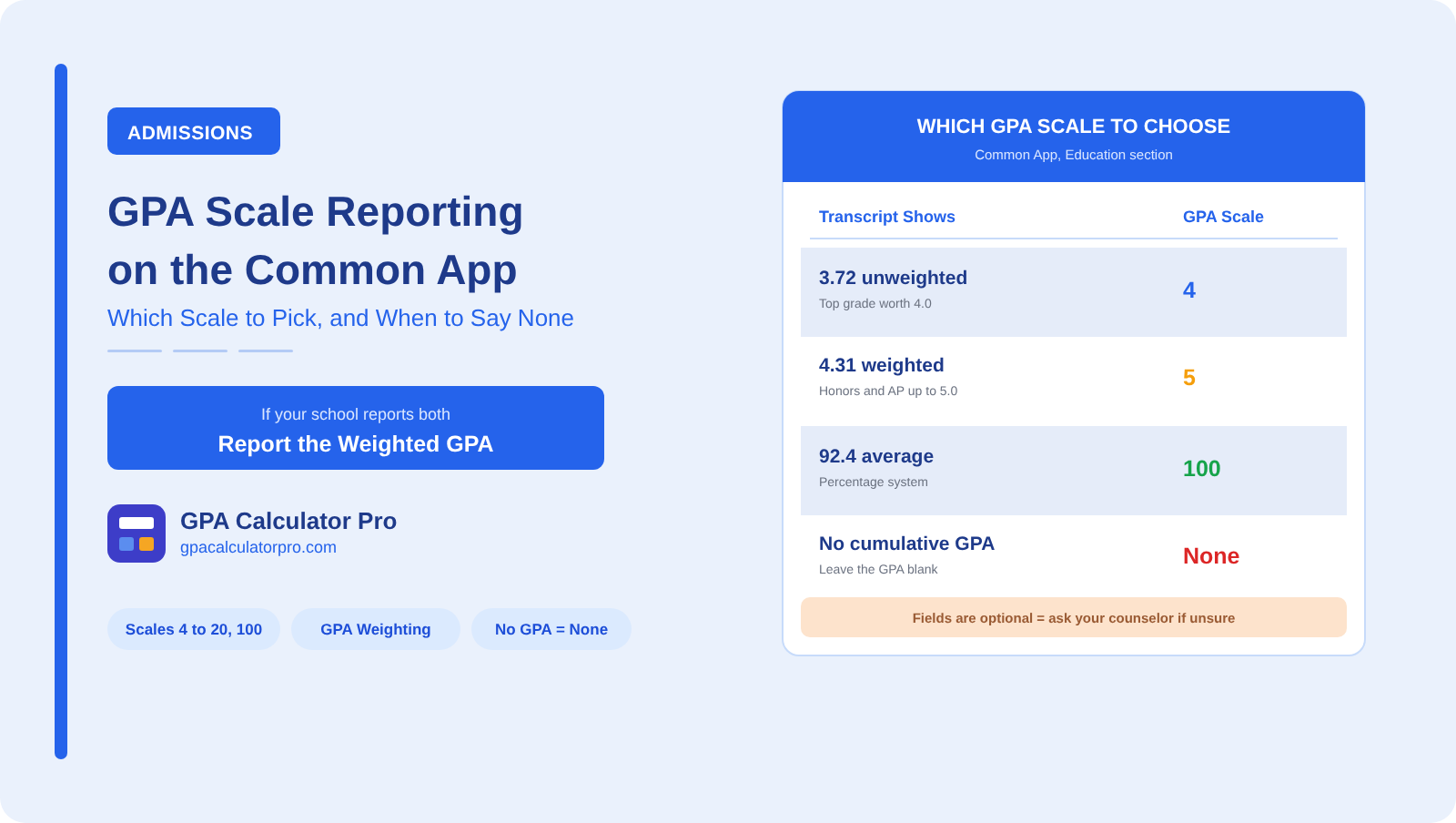
GPA scale reporting means telling colleges which GPA system your school uses, so they can read your GPA correctly. On the Common App, you enter your cumulative GPA, choose its GPA scale from a drop-down menu (4 through 20, or 100) and say whether it is weighted or unweighted. If your school has no GPA, you choose None.
This guide explains where the fields are, how to find the right answers on your transcript, and the mistakes that cause confusion. Everything here follows the Common App's own high school details information sheet, linked at the end.
What "GPA Scale Reporting" Means
A GPA on its own is ambiguous. A 3.6 is a strong result on a 4-point scale, an average one on a 5-point weighted scale, and impossible to read at all if the reader does not know which system produced it. Schools around the world use different scales, so the Common App asks for the scale next to the number.
The scale is the highest value your school's GPA system can produce. If the top grade in your school's system is worth 4.0, your scale is 4. If honors and AP courses can earn up to 5.0, your weighted scale is 5. If your school reports a percentage average, your scale is 100.
Where GPA Scale Appears on the Common App
The GPA questions are in the Education section, in the part about grades. The Common App's information sheet lists these fields:
| Common App field | What you enter |
|---|---|
| Graduating class size | Approximate number of students in your class |
| Class rank reporting | Exact, Decile, Quintile, Quartile or None |
| Cumulative GPA | Your overall GPA, as your transcript shows it |
| GPA scale | 4 through 20, 100, or None |
| GPA weighting | Weighted or Unweighted |
The scale menu offers every whole number from 4 to 20, plus 100 and None. That covers 4.0 and 5.0 systems in the US, 10-point and 20-point systems used in other countries, and percentage averages.
How to Find Your Scale on Your Transcript
You should not have to work anything out. The answers are normally printed on documents your school already has:
- Your transcript. Look for "Cumulative GPA" near the bottom. Many transcripts print the scale next to it, such as "3.72 / 4.00", or label it weighted or unweighted.
- The transcript key or legend. This is often printed on the back of the transcript and lists what each grade is worth. The highest value in the list is your scale.
- Your school profile. Most high schools publish a one-page profile for colleges that explains the grading and weighting system.
- Your school counselor. Counselors receive the same information sheet from the Common App, and many hand out a filled-in copy so every student enters the same answers.
Use your cumulative GPA, covering every year so far, not a single semester or year. If you want to understand how your school arrived at it, the High School GPA Calculator lets you rebuild it from your grades, but enter the figure your school reports.
Weighted or Unweighted: Which GPA to Report
The Common App asks you to report one cumulative GPA, then mark it Weighted or Unweighted in the GPA weighting field.
- Your school calculates one GPA. Report that GPA and choose the weighting that describes it.
- Your school calculates both. The Common App's guidance is that students should report the weighted value. Choose Weighted, and choose the scale that goes with the weighted figure.
The scale and weighting have to describe the same number. A weighted GPA of 4.31 cannot sit on a scale of 4, because the scale is the maximum. If your school's weighted GPA can reach 5.0, the scale is 5. For how weighted GPAs are built in the first place, see how to calculate weighted GPA.
Examples: 4.0, 5.0 and 100-Point Schools
Here is what four common transcripts translate to on the Common App:
| Your transcript | GPA to enter | Weighting |
|---|---|---|
| 3.72 Unweighted, out of 4.0 | 3.72 Scale: 4 | Unweighted |
| 4.31 and 3.85 Weighted (max 5.0) and unweighted | 4.31 Scale: 5 | Weighted |
| 92.4 Average out of 100 | 92.4 Scale: 100 | Your school's |
| Grades only No cumulative GPA | Blank Scale: None | Blank |
"None" appears as N/A in some versions of the guidance. For a 100-point average, choose the weighting your school uses for that average; if it is a plain average of your grades, that is Unweighted. If your school uses a scale that is not on the menu, such as 4.3, the Common App says to select N/A. Your counselor can confirm how your school wants students to handle it.
No GPA on Your Transcript?
Some schools do not calculate a cumulative GPA at all. They may give written evaluations, use pass/fail grading, or only report course grades. In that case:
- Leave the cumulative GPA blank.
- Choose None (N/A) as the GPA scale.
- Do not calculate a GPA yourself to fill the gap. A number your school has not issued can conflict with what colleges see on your transcript.
Colleges still receive your transcript and see every grade, so an empty GPA field does not leave a gap in your application.
Common Mistakes to Avoid
- Converting to a 4.0 scale yourself. Enter your GPA on your school's own scale. The scale field exists so colleges can do the interpretation.
- A scale below your GPA. Choosing 4 for a weighted GPA of 4.31 tells colleges something impossible.
- The wrong weighting label. Make sure the Weighted or Unweighted choice matches the figure you entered.
- Rounding up. Copy the figure as it appears on your transcript. Colleges compare it with the transcript itself.
- Using a semester GPA. The field asks for your cumulative GPA across all years so far.
- Guessing. If you cannot tell which scale applies, ask your counselor. The fields are optional, so leaving them blank beats entering something wrong.
Your GPA is one of the most important parts of a college application, which is covered in does high school GPA matter for college? Getting the reporting right simply makes sure it is read the way your school intended.